Sunday, March 20, 2011

B-2s fly from Whiteman to bomb Libya


WASHINGTON (AFP) – The world's most expensive warplane rarely leaves its climate-controlled hangar but when it does, the B2 bomber makes a spectacularly effective start to a war -- including during this weekend's attack on Libya's air defenses.

The mission of the B2 Spirit stealth bomber is to penetrate heavily defended enemy territory and "kick down the door" on the opening night of a conflict, and the stealth aircraft has been put to that use during the Iraq War, Kosovo and Afghanistan.

Costing 2.1 billion dollars each, the B2 has a contoured, radar absorbing skin that makes it almost impossible to detect.

The long-range, heavy bomber capable of penetrating sophisticated and dense air-defense, and with one refueling, is able to fly to any point in the world within hours.
The aircraft is famous for rather ominous-looking bat-like silhouette: The leading edges of the wings are angled at 33° and the trailing edge has a double-W shape. It is manufactured at two Northrop Grumman facilities in Pico Rivera and Palmdale in California.

The aircraft also are deadly and effective: An assessment published by the USAF showed that two B2s armed with precision weaponry can do the job of 75 conventional aircraft

That makes it a powerful weapon to strike targets including bunkers, command centers, radars, airfields, air defenses.
The B2 can carry 16 2,000 pound (900 kilogram), satellite-guided bombs, including an earth penetrating version.
It also is the only US warplane equipped to deliver the GBU-37 "bunker buster," a 5,000 pound (2,250 kilo) bomb with a hardened nose that can bore through 20 to 30 feet of rock or reinforced concrete before detonating.
Its bomb bays can carry eight GBU-37s, and it also can carry 16 Joint Air to Surface Standoff Missile (JASSM), which have been tested at ranges 180 miles (290 kilometers) from the target, or the Joint Standoff Weapon (JSOW), a glide bomb that releases cluster bombs.

A major drawback, however, is the intensive maintenance required by the B2s, whose heat and moisture sensitive skin must be painstakingly taped and cured after every mission.
In previous conflicts, the maintenance requirements kept the B2s tethered to their home base at Whiteman Air Force Base in Missouri.

In Afghanistan, that meant 44-hour bombing runs for their two-member crews, the longest air combat missions in history. It also meant few B2 missions.

But the air force has built special climate controlled shelters at bases on the Indian Ocean island of Diego Garcia and at Fairford, England for B2s, which were built by Northrop Grumman and first flew in 1989.

However, US defense officials said Sunday that three B-2 Stealth bombers flew non-stop from Whiteman Air Force Base, Mo., dropping 40 bombs on a major Libyan airfield in an attempt to destroy much of Ghadafi's air force.

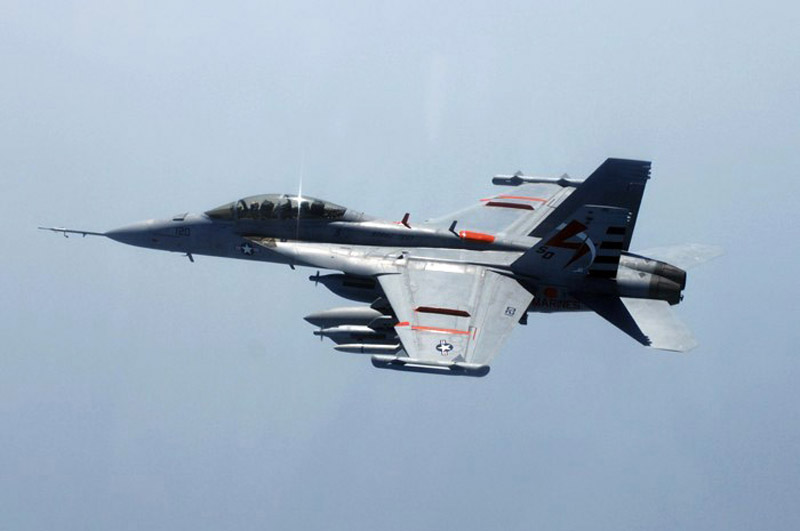
Growls and Harriers growl over Libya ...


Mediterranean Sea, Mar 20, 2011 — U.S. Navy EA-18G Growlers positioned in coalition military bases and U.S. Marine Corps AV-8B Harriers aboard the USS Kearsarge (LHD3) launched during the early hours in support of Operation Odyssey Dawn to enforce U.N. Security Council Resolution 1973, which is centered on protecting Libyan citizens from any further harm from Libyan leader Muammar al-Qadhafi's regime, March 20, 2011.

U.S. Navy Growlers provided electronic warfare support over Libya while AV-8B Harriers from the 26th Marine Expeditionary Unit conducted strikes against Qadhafi 's ground forces and air defenses joining an international effort to halt an offensive against the Libyan populace.

"Protecting the innocent and conducting combined operations are what we are designed to do," said Colonel Mark J. Desens, commanding officer of 26th MEU. "Our forces are doing both as part of the U.S. commitment to protect Libyan citizens."

Joint Task Force Odyssey Dawn is the U.S. Africa Command (AFRICOM) task force established to provide operational and tactical command and control of U.S. military forces supporting the international response to the unrest in Libya and enforcement of United Nations Security Council Resolution (UNSCR) 1973. UNSCR 1973 authorizes all necessary measures to protect civilians in Libya under threat of attack by Qadhafi regime forces. JTF Odyssey Dawn is commanded by U.S. Navy Admiral Samuel J. Locklear, III.

B-2 Stealth Bombers pound Libyan AirField


WASHINGTON — Three US B-2 stealth bombers have dropped 40 bombs on a major Libyan airfield.
There was no immediate official confirmation of the attack.

On Saturday, the United States unleashed a barrage of Tomahawk missiles against the Libyan regime's air defenses, but ruled out using ground troops in what President Barack Obama called a "limited military action".

Nineteen U.S. warplanes, including stealth bombers and fighter jets, conducted strike operations in Libya on Sunday morning, officials said.

Tomahawk cruise missiles are unmanned and fly close to the ground, steering around natural and man-made obstacles to hit a target programmed into them before launch.

A senior U.S. military official, who was not authorized to speak on the record, said the cruise missiles landed near the city of Misrata and the capital, Tripoli.

Scores of missiles were fired in the pre-dawn darkness, and the exact results of the mission were not immediately clear. The United States is expected to conduct a damage assessment of the sites.
The salvo, in an operation dubbed "Odyssey Dawn," was meant "to deny the Libyan regime from using force against its own people," Gortney said.

British Defense Secretary Liam Fox said the Royal Air Force deployed Tornado GR4 fast jets, which flew 3,000 miles from the United Kingdom and back -- making the venture the longest-range bombing mission conducted by the force since the Falklands conflict in 1982.

British Prime Minister David Cameron said the international mission "is necessary, it is legal, and it is right."

"I believe we should not stand aside while this dictator murders his own people," Cameron said late Saturday night.

But Gadhafi remained defiant, saying Libya will fight back against undeserved "naked aggression."

Saturday, March 19, 2011

Who's - who over Libya ...


In all, the U.S. Navy has five combat ships in the Mediterranean, including at least one guided-missile destroyer, but there are no U.S. aircraft carriers close to Libya.

The USS Enterprise, which recently was stationed in the Red Sea, has been moved eastwards, away from Libya, to join the USS Carl Vinson, in the Arabian Sea to support Afghanistan operations.


—Has two guided-missile destroyers in the Mediterranean, the USS Barry and USS Stout, two amphibious warships, the USS Kearsarge and USS Ponce, and a command-and-control ship, the USS Mount Whitney. The submarine USS Providence was also in the Mediterranean.

—Witnesses reported five F-18s, two C-17s and a C-130 cargo plane arrived at U.S. air base at Aviano in northern Italy, which is home to the 31st Fighter Wing.

Aviano, south of the Alps in Italy, is the region's only U.S. air base with aircraft assigned to it -- 42 F-16s. The Pentagon has not discussed the positioning of other planes in the region. The United States has a range of Mediterranean military bases and installations in Italy, Greece, Spain and Turkey.

CANADA

Canada's HMCS Charlottetown warship has joined naval actions, including a naval blockade, taking place off Libya, Prime Minister Stephen Harper told reporters.

Canadian fighter jets have reached the region but need another day or two of preparation before they can join the mission, a Canadian government spokesman said.

ITALY

Italy has deployed dozens of combat aircraft at its base at Trapani, in western Sicily in readiness for possible involvement in airstrikes on Libya.

Tornado fighters that can be used to destroy enemy air defenses and radar as well as F-16s and Eurofighters used for air-to-air defense have been moved to Trapani from bases in Piacenza in northern Italy, Gioia del Colle in Apulia.

Italy has offered the use of a NATO base near Naples for joint command center for the joint operation, and could participate later on in military activities, Prime Minister Silvio Berlusconi said.

Defense Minister Ignazio La Russa said in all seven bases in Italy -- at Amendola, Gioia del Colle, Sigonella, Aviano, Trapani, Decimomannu and Pantelleria -- were available and some allies had asked to use them.

Five are on the southern mainland or Sicily, making them some of the closest available bases to Libya.

FRANCE

—Deployed eight Rafale and four Mirage jets to survey rebel-held Benghazi; one fired on a Libyan military vehicle in first military strike of operation.
—Six C-135 refueling tankers
—1 AWACS surveillance plane
—Deploying the Charles de Gaulle aircraft carrier to the region Sunday from Toulon
—Also envisages using anti-air frigates Jean-Bart and Forbin, anti-submarine frigate Dupleix, the Aconit frigate and a refueling ship La Meuse.

DENMARK:

—Six F-16s arrived at U.S. air base in Sigonella, Sicily and could be deployed as early as Sunday; 132 support staff.

Spain:
—Sent four F-18s and a Boeing 707 refueling plane to Italy base.
—Deploying a submarine, naval frigate and a surveillance plane.
—Placed two bases at NATO's disposal, Rota and Moron de la Frontera, where several U.S. Air Force planes were seen Friday.

BRITAIN

—Said it would send Typhoon and Tornado jets to air bases, but no British fighter assets have yet been forward deployed, the Ministry of Defense said.

Tornadoes took off from RAF Marham in Norfolk shortly after a barrage of 112 Tomahawk cruise missiles - some of them British - was fired at Libya to knock out the dictator's air defence systems at more than 20 coastal locations.

—Britain's air base in southern Cyprus, RAF Akrotiri, supporting AWACS surveillance aircraft and has a team of personnel there to coordinate British aircraft movement.
—Two British frigates, HMS Westminster and HMS Cumberland, are in the Mediterranean off Libya's coast.


NORWAY

—Offered six F-16s, with around 100 support staff, but operational capabilities five-six days off.
—Considering contributing an Orion maritime surveillance plane.

Brits fly from AF Marham to pound Libya


RAF jets join international action
(UKPA) – 1 hour ago
At least three RAF Tornado jets set off from the UK on Saturday night to take part in the operation to enforce a no-fly zone over Libya as the international community swung into action against Muammar Gaddafi.


The flights took off from RAF Marham in Norfolk shortly after a barrage of 112 Tomahawk cruise missiles - some of them British - was fired at Libya to knock out the dictator's air defence systems at more than 20 coastal locations.


A Royal Navy Trafalgar-class submarine stationed in the Mediterranean took part in the co-ordinated assault, which also involved forces from the US, France, Italy and Canada under the operational control of US Africa Command.


The missiles targeted radar systems and ground-to-air missile sites around the cities of Tripoli and Misrata in what was described as "the first phase of a multi-phase operation", clearing the way for allied planes to take control of the skies.


The onslaught on Gaddafi came after an emergency summit in Paris agreed military action to enforce United Nations resolution 1973, which authorised "any necessary measures" short of foreign occupation to defend Libyan civilians.


Around 20 French Mirage and Rafale fighter jets were immediately sent into action over the rebel stronghold of Benghazi, firing the first shots of the operation to destroy a number of Gaddafi's tanks and armoured vehicles.


Benghazi had come under fierce attack during the day, despite a supposed ceasefire, raising fears that Gaddafi would take advantage of delays in the international response to smash the opposition and commit atrocities against those who rose up against his 42-year rule a month ago.
Prime Minister David Cameron announced that British forces had gone into action in a brief statement outside 10 Downing Street following a meeting of senior ministers and military top brass in the Government's Cobra emergency committee.


As he initiated his first military campaign as PM, Mr Cameron described the operation as "necessary, legal and right". His thoughts were with British service personnel who were risking their lives to save others, he said.

President Barack Obama, making a visit to Brazil, said the US would contribute its "unique capabilities" to enable the enforcement of a no-fly zone which will be led by its international partners. Repeating his pledge that no US ground troops will be sent to Libya, Mr Obama said the "limited" use of force was "not an outcome the US or any of our partners sought". But he added: "We can't stand idly by when a tyrant tells his people that there will be no mercy."

LinkWithin

Blog Widget by LinkWithin