Tuesday, June 3, 2025

Updated: Did SecDef Pete Hegseth visit Area 51?


Original post by Joerg Arnu - Dreamland Resort: 

BEGIN QUOTE: 

So, here is the summary after going through the flight data:

There was a VVIP presentation at Area 51, likely related to the Boeing F-47 or the NGAD project in general, on Sunday, 6/1/2025 between 8:10am and 9:30am. VVIPs present were SECDEF Pete Hegseth and Chairman of the Joint Chiefs of Staff, General Caine on their way back to DC from the Shangri-La Dialogue in Singapore on 5/30/25. They landed at Nellis AFB and boarded Area 51 commuter shuttle aircraft to Area 51.

--- Details by personnel involved ---

SECDEF Pete Hegseth
-------------------
7:20am arrived at Nellis AFB from Singapore with TITAN29
8:10am arrived at Area 51 with JANET01
10:05am arrived back at Nellis AFB with JANET01
10:34am departed Nellis AFB to Andrews AFB, Washington DC without tracking

Chairman of the Joint Chiefs of Staff, General Caine
----------------------------------------------------
5:50am arrived at Nellis AFB from Singapore with SAM699
8:06am arrived at Area 51 with JANET10
9:58am arrived at Nellis AFB with JANET09
10:34am departed Nellis AFB to Andrews AFB, Washington DC with SAM699

Support and/or security personnel from DC
-----------------------------------------
5:30pm (Sat 5/31) arrived at Nellis AFB from Andrews AFB, Washington DC
8:00am arrived at Area 51 with JANET09
12:25pm arrived at Nellis AFB with JANET10
1:30pm departed Nellis AFB back to Andrews AFB, Washington DC

Personnel from Area 51 needed for the presentation
--------------------------------------------------
7:10am arrived at Area 51 with JANET82
12:55pm departed Area 51 with JANET82

--- Details by aircraft involved ---

TITAN29, hex ADFEB4, reg 73-1677: USAF "Nightwatch" E-4B (Boeing 747-200B), Advanced Airborne Command Post (AACP) for the National Emergency Airborne Command Post (NEACP) program. Serves as a survivable mobile command post for POTUS and SECDEF.
7:20am arrived at Nellis AFB from Paya Lebar Air Base, Singapore
Departure from Nellis AFB unknown, likely back to Andrews AFB, Washington DC with SAM699 under their tracking
SECDEF Pete Hegseth, after attending the 22nd Shangri-La Dialogue in Singapore on 5/30/25

SAM699, hex AE11F6, reg 01-0041: USAF C-40C (Boeing 737-700), 1st Airlift Squadron, VVIP transport, "Special Air Mission"
5:50am arrived at Nellis AFB from Paya Lebar Air Base, Singapore
10:34am departed Nellis AFB to Andrews AFB, Washington DC
Chairman of the Joint Chiefs of Staff, General Caine after introductory visit to Singapore and attending the 22nd Shangri-La Dialogue on 5/30/25

JANET01, hex A8B80A, reg N661BA: Executive commuter shuttle for area 51 personnel
7:51am departed Nellis AFB
8:10am arrived at Area 51
9:40am departed Area 51
10:05am arrived at Nellis AFB
SECDEF Pete Hegseth

JANET09, hex ADCE1A, reg N989RR: Executive commuter shuttle for area 51 personnel
7:42am departed Nellis AFB
8:00am arrived at Area 51
9:35am departed Area 51
9:58am arrived at Nellis AFB
Chairman of the Joint Chiefs of Staff, General Caine

JANET10, hex AC96DF, reg N910CB: Executive commuter shuttle for area 51 personnel
7:48am departed Nellis AFB
8:06am arrived at Area 51
12:00pm departed Area 51
12:25pm arrived at Nellis AFB
Support and/or security personnel from DC

SPAR22, hex AE189A, reg 05-4613: USAF C-40C (Boeing 737-700), 73rd Airlift Squadron, airlift for distinguished visitors and their staff
5:30pm (Sat 5/31) arrived at Nellis AFB from Andrews AFB, Washington DC
1:30pm (Sun 6/1) departed Nellis AFB back to Andrews AFB, Washington DC
Support and/or security personnel from DC

JANET82, hex ABF0FD, reg N869HH: Boeing 737-600, area 51 personnel commuter shuttle
6:56am departed Las Vegas Janet terminal
7:10am arrived at Area 51
12:55pm departed Area 51
1:19pm arrived at Las Vegas Janet terminal
Personnel from Area 51 needed for the presentation

END QUOTE.

You can read more in the discussion forum at Dreamland Resort

More analysis from IntelFrog on X. 


click to enlarge 


UPDATED: Ukraine drone attacks on Russia's nuclear bombers changes everything.

Various sources: WASHINGTON − Ukraine destroyed dozens of enemy bombers using a horde of drones smuggled deep into Russia in a stunning attack that Russian war bloggers are calling Moscow's Pearl Harbor. It was the most damaging Ukrainian attack on Russia in the three years since Moscow invaded. More: Ukraine says it hit Russia's bridge to Crimea with underwater explosives Ukrainian intelligence said the coordinated strikes on June 1 took a $7 billion toll on Russia's military and demolished more than a third of Moscow's strategic cruise missile carriers, including planes capable of carrying nuclear warheads. 

 Ukrainian President Volodymyr Zelenskyy called the massive attack, which he said used 117 drones, his country's "longest-range operation." "It had an absolutely brilliant outcome," Zelenskyy said on Telegram. "Russia has had very tangible losses, and justifiably so." Oksana Markarova, Kyiv's ambassador to the United States, called the attack a "very successful defensive operation in Russia against Russian aircraft that, on a daily basis, bomb our hospitals and schools and kill our kids." Speaking at an AI event in Washington, Markarova said it was "the best example of how innovation can and should work in defense." With Ukraine set to meet Russia for U.S.-brokered peace talks the next day and amid aggressive Russian advances on the battlefield, the ambitious June 1 attack showed neither side is counting on a breakthrough in negotiations. "We hope that the response will be the same as the US response to the attack on their Pearl Harbor or even tougher," Russian war blogger Roman Alekhin wrote on Telegram, comparing the Ukrainian strike to the 1941 Japanese raid on a U.S. base in Hawaii. “It is impossible to restore these losses,” reported Rybar, a pro-Kremlin Telegram channel. The comparisons between the Ukrainian drone attack and the 1941 Pearl Harbor attack bandied by pro-

Russian bloggers were not historically accurate. Japan's Dec. 7, 1941, bombing of the U.S. naval base in Hawaii, which pulled the U.S. into World War II, destroyed and damaged more than 300 American planes and killed more than 2,400 servicemembers, according to the National World War II Museum. Ukrainian 'Spider's Web' . The operation, code-named "Spider's Web," was characteristic of the style of warfare Ukraine has made its brand as it attempts to undercut Russia's larger military – flooding the zone with cheap, deadly drones. But the scope of this attack set a new precedent. The drones, strapped with explosives, were hidden inside trucks that parked at the outer edge of Russian military bases, a 

Ukrainian security official told Reuters. Video shows one of the abandoned trucks self-destructing when a person went inside after the drones were launched. The roofs then opened by remote control, unleashing the drones to swarm the military bases. Ukraine's intelligence service said 41 Russian aircraft were hit at four air bases stretching from the Finnish border to Siberia. One targeted base, in the Irkutsk region, lies more than 2,600 miles from the front lines, making it the farthest target Ukraine has hit during the conflict. Russia's defense ministry acknowledged in Telegram messages June 1 that drones launched "from an area in close proximity to airfields resulted in several aircraft catching fire." The operation came a day after Russia launched a massive overnight attack on Ukraine using 472 drones and seven missiles, according to Ukraine's air force – the most drones launched in one operation throughout the conflict. 

Separately on June 1, Ukraine struck two highway bridges in Russian regions close to its borders, killing seven people and injuring 69. One bridge collapsed on a train carrying nearly 400 passengers to Moscow, according to Russian investigators. Three of the missiles and 372 drones were downed, the air force said. 

 Michael Boyle, an associate Professor at Rutgers University and author of a book on drone warfare says “There's a lot of counter-drone technology that gets rendered pretty useless against drones operating on a closed loop with fiber optic cables, and [militaries] are going to need to rethink the counter-UAS strategies to deal with fiber-optic drones, even if attacks like we saw in Russia remain rare and hard to replicate.” Military air bases are protected with layered systems that often include radar to detect approaching threats, as well as missile systems and jamming devices designed to disorient radio-controlled drones. 

 The June 1 attacks rendered nearly all such defences void. In flying from short range, the drones arrived without the warning that long-range radar can provide, and in swarms likely to overcome even missile defense systems able to shoot down such small devices. In some videos made on June 1, small arms fire can be heard as Russian servicemen apparently attempt to shoot down the quadcopters. Colonel Markus Reisner, the head of Research and Development for the Austrian Military Academy told RFE/RL the attack offers “a taste of the future of warfare.” Reisner says since the start of the war Moscow has struck Ukraine using “long-range Tu-22, Tu-160, and Tu-95 bombers. 

During these regular attacks, the heavy bombers launch their long-range cruise missiles from a safe distance and outside the range of Ukrainian air defenses. Ukraine has therefore repeatedly attempted to take out these heavy bombers and the important A-50 flying communication centers in recent years.” Depending on which of the varying estimates of destroyed aviation destruction turns out to be accurate, Reisner believes the Ukrainian operation will “contribute to significantly reducing the intensity of Russian air strikes on Ukraine.” Colonel Markus Reisner, the head of Research and Development for the Austrian Military Academy told RFE/RL the attack offers “a taste of the future of warfare.” Following 

Ukraine’s stunning attack over the weekend that used small drones to target and destroy Russia’s strategic bombing aircraft, the U.S. Army is applying big picture observations to its ongoing force transformation. For starters, leaders believe it is a validation of some of the radical change the service is seeking in how to procure and manage capabilities differently in the future. 

 “Yesterday was a really good example of just how quickly technology is changing the battlefield. We’ve seen this over the last couple of years that everybody talks about [Program Objective Memorandum] cycles and everybody talks about program of record. I think that’s just old thinking,” Gen. Randy George, chief of staff of the Army, said Monday during the Exchange, an AI conference hosted by the Special Competitive Studies Project. POM cycles refer to the five-year planning process for programs and capabilities in the Pentagon. 

George noted that technology is changing too rapidly on the modern battlefield to be wedded to these large procurement programs that historically have taken years to develop and once fielded, can be largely obsolete. He wants to shrink the timeline it takes to develop systems and get them in the hands of soldiers, especially given much of these capabilities, such as drones, communications gear and electronic warfare tools, are increasingly available on the commercial market. “What we got to do is make sure that we’re aligned and that’s what we’re trying to do, changing the processes up here to make sure that we’re getting them the equipment, the war-winning capabilities that they know they need,” he said. “We’re going to have to be more agile. Drones are going to constantly change. We’re going to be trying to play the cat-and-mouse game with counter-UAS, so we’re going to have to work through that to make sure that we’re buying systems. We’re going to need a lot more agility in how we buy things.” 

 The Army has been experimenting with this approach through what it calls transforming-in-contact, which aims to speed up how the service buys technologies and designs its forces by injecting emerging capabilities into units and letting them experiment with them during exercises and deployments. George said one of the Army’s units that just went to the Joint Readiness Training Center at Fort Johnson, Louisiana — which provides the most realistic combat scenarios the Army can create for units to train where forces simulate a battle campaign against an active enemy — had close to 400 drones in it. That is substantially higher than the number of drones other formations have had recently, with 3rd Brigade, 10th Mountain Division possessing over 200 during a January rotation in Europe, previously the most to date. he Army doesn’t want to field the same systems like that for years because the technology changes so rapidly. “We’re constantly updating those. I think that that’s how we have to be focused moving forward,” George said. He also noted that Ukraine’s drone attack over the weekend flips the cost curve. 

Kyiv used relatively cheap systems to destroy millions to billions of dollars worth of Russian combat power. “Look at how cheap those systems were compared to what they took out. We have to be thinking about that [with] everything we’re doing,” George said. The attack, furthermore, exemplified how transparent battlefields are becoming, meaning there is nowhere to hide.


UPDATED DAMAGE ASSESMENT PHOTOS:


Monday, May 19, 2025

First B61-13, the latest nuclear gravity bomb, nearly a year ahead of schedule.


AMARILLO, Texas (KVII) — The Pantex Plant in Amarillo completed the first B61-13, the latest nuclear gravity bomb, nearly a year ahead of schedule.

U.S. Secretary of Energy Chris Wright stamped the bomb during a ceremony on Monday.

“Modernizing America’s nuclear stockpile is essential to delivering President Trump’s peace through strength agenda,” said Secretary of Energy Chris Wright. “The remarkable speed of the B61-13’s production is a testament to the ingenuity of our scientists and engineers and the urgency we face to fortify deterrence in a volatile new age."

The B61 is the longest-serving and most versatile weapon in the U.S. nuclear stockpile.


While the B61 family can be delivered by a broad range of fighter and bomber aircraft, the B61-13 will only be certified for delivery by strategic bomber aircraft and deployed from bases in the continental United States.

“Accelerating production of the B61-13 while maintaining the highest standards of safety and security, and without disrupting our other six modernization programs, is a remarkable achievement,” said David Hoagland, Acting Deputy Administrator for Defense Programs.

The entire project is expected to be finished in 2027.


Wednesday, March 5, 2025

B-52 possibly carrying Lockheed's AGM-183 spotted over Texas.


A B-52 flying from Barksdale AFB to Dugway proving grounds in Utah was photographed over Texas with what looks like might be a Lockheed AGM-183 hypersonic missile. Flight tracks showed it possibly launched from Barksdale, AFB in Louisiana,

The AGM-183 ARRW ("Air-Launched Rapid Response Weapon") is a hypersonic air-to-ground ballistic missile planned for use by the United States Air Force

Developed by Lockheed Martin, the boost-glide vehicle is propelled to a maximum speed of more than Mach 5 by a rocket motor before gliding toward its target. The program was cancelled in March 2023 after multiple failed tests. 

The program, however, continued despite the cancellation and was announced to still be in development following additional, undisclosed testing. However in 2024 it was announced that in the fiscal year 2025 budget, no funding would be provided for procurement or further research and development.

The AGM-183A had a claimed maximum speed of more than 15,000 miles per hour (24,000 km/h; Mach 20[disputed (for: disagreement between sources. 

The weapon used a boost-glide system, in which it was propelled to hypersonic speed by a rocket on which it was mounted before gliding toward a target.

According to Popular Mechanics, the U.S. Air Force was, as of April 2020, considering using the remaining fleet of B-1B bombers as AGM-183A firing platforms, with each aircraft carrying up to 31 hypersonic weapons (between ARRW and HAWC) mounted on the Common Strategic Rotary Launcher and on external pylons.

On March 17, 2024, the USAF conducted its final planned end-to-end test launch of the AGM-183A, successfully launching one out of a B-52 bomber taking off from Andersen Air Force Base. According to a USAF statement issued on 20 March. “The Air Force gained valuable insights into the capabilities of this technology,” the statement added without giving further details, including whether the test was deemed a success

On March 29, 2023, Assistant Secretary of the Air Force for Acquisition, Technology and Logistics, Andrew Hunter told the House Tactical Air and Land Forces Subcommittee, a committee responsible for providing oversight for military ammunition, acquisition, and aviation programs, that the AGM-183A program would not proceed, although the ARRW program's last two all-up round test flights would proceed in order to collect data to help with future hypersonic programs.[8] In the Fiscal Year 2025 budget, released March 11, 2024, no funding was provided for procurement or further research and development of the AGM-183, effectively ending the project, but with this new possible sighting over Texas (not yet confirmed) it may be that testing and (or) fielding of the weapon may have resumed.

Russia is developing at least three hypersonic weapons that are operational or approaching operational status. These systems, introduced by Russian President Vladimir Putin in his 2018 and 2019 speeches to the Federal Assembly, address requirements for Russian regional and strategic strike capabilities, and all are capable of carrying nuclear warheads. While these systems could pose problems for U.S. and NATO defense planning, their introduction in the near-term is not likely to fundamentally alter the existing balance of power or the prospects for strategic stability.

Flying in broad daylight and easily photographed, the sighting may have been a subtle way to let Russia know that U.S. hypersonic missile tests are proceeding. The aircraft appears to be B-52H 61-0028 as featured on The Aviationist. LINK


(C) Steve Douglass webbfeat@gmail.com 

enhanced (C) Steve Douglass 


(C) Steve Douglass webbfeat@gmail.com 


Thursday, January 30, 2025

WAPO: What we know about the plane and military helicopter crash in D.C.


By Kelly Kasulis Cho,

Helier Cheung and Tobi Raji WAPO


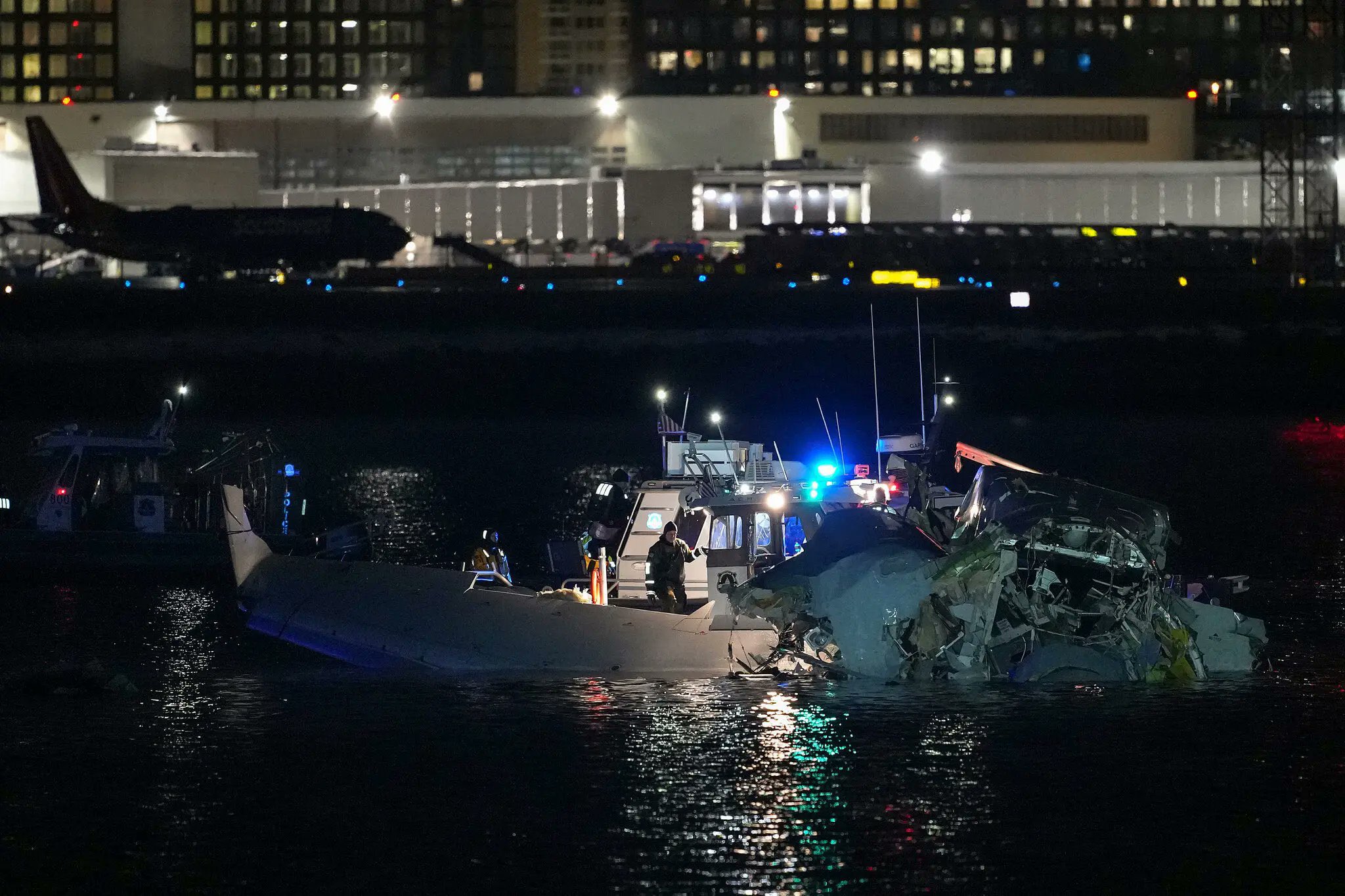
An American Airlines plane and an Army Black Hawk helicopter collided in midair near Reagan National Airport on Wednesday night. Both aircraft crashed into the Potomac River in Washington. Police had pulled 28 bodies from the water as of Thursday morning, according to officials, who believe all passengers and crew aboard the airplane were killed. National Airport reopened to air traffic Thursday morning.

Here’s what we know about the crash so far.

The crash:
American Airlines said 60 passengers and four crew members were aboard American Eagle Flight 5342 from Wichita. The flight — a Bombardier CRJ700 regional jet operated by American Airlines subsidiary PSA Airlines — was set to land in Washington at 8:57 p.m., according to aircraft tracker FlightAware. All are believed to have died in the crash.


The plane and an Army UH-60 Black Hawk helicopter that was on a training flight collided at 8:47 p.m., according to publicly available flight-tracking data. The helicopter was from the 12th Aviation Battalion at Fort Belvoir in Virginia, Defense Secretary Pete Hegseth said in a video posted Thursday morning.

The military helicopter was found upside down in the water and the plane had broken into pieces, according to a D.C. official who spoke on the condition of anonymity because they were not authorized to speak publicly.
Weather around the time of the incident was not out of the ordinary. National Airport reported clear skies, visibility of 10 miles and winds sustained from the northwest at 16 mph, gusting to 26 mph. The temperature was 50 degrees.

The victims
About 20 members of the U.S. Figure Skating community were aboard the American Airlines jet, according to a person professionally involved in the sport who spoke on the condition of anonymity to discuss a sensitive matter. Athletes, coaches and family members were returning home from the National Development Camp held in conjunction with the U.S. Figure Skating Championships in Wichita.

Four D.C.-area steamfitters were also aboard the jet, the United Association of Union Plumbers, Pipefitters and Steamfitters Local 602 said in a statement Thursday morning. The four were members of Steamfitters Local 602 — a Prince George’s County, Maryland-based union that represents steamfitters and pipe fitters in the D.C. area.

The Association of Flight Attendants, which represents cabin crews at PSA Airlines, said in a statement that two flight attendants were on board the plane.
The military is withholding the identities of the soldiers aboard the helicopter because it has not yet notified all surviving family members, Hegseth said Thursday morning, describing the crew as “fairly experienced.” No senior U.S. leaders were aboard the Black Hawk, two defense officials said, speaking on the condition of anonymity because of the sensitivity of the matter

Recovery and investigation efforts

The National Transportation Safety Board is leading an investigation into the incident, with help from the Federal Aviation Administration. On Thursday, President Donald Trump tapped Chris Rocheleau, chief operating officer of the National Business Aviation Association, as the FAA’s acting administrator.
All passengers and crew aboard the plane are presumed dead, officials said. Police had pulled 28 bodies from the water, Donnelly said Thursday morning: 27 from the plane and one from the helicopter.
The Army unit involved in the training flight — the 12th Aviation Battalion at Fort Belvoir in Virginia — has paused operations for 48 hours, Hegseth said. The Defense Department is investigating the incident.

The Coast Guard, Maryland State Police, Metro Transit Police and Maryland Department of Natural Resources have been deployed to the scene. Dive teams from Prince George’s County have also pitched in. D.C. Fire and EMS Chief John A. Donnelly Sr. said he expects operations at the crash site to continue for days, and that the weather is “extrmely rough for the responders.”
The temperature hovered 50 degrees Thursday during the day with light winds — a stark change from Wednesday, when it reached 64 degrees with blustery winds. Water temperatures in the Potomac are in the mid-30s.

Crews found debris as far south as the Woodrow Wilson Bridge, about a mile from the crash, Donnelly said Thursday morning. Nearby National Harbor has been closed to assist search and recovery efforts, acting Prince George’s County Executive Tara Jackson said Thursday morning in a post on X.
Transportation Secretary Sean P. Duffy said Thursday morning that “everything was standard in the lead-up to the crash” but “obviously, something happened here” to cause the plane and helicopter to collide. “Something went wrong here,” he said, adding that he hopes to release more information later. “Do I think this was preventable? Absolutely,” he added.

During a news conference Thursday, Trump first pinned the deadly collision on air traffic control, saying “the warnings were given very very late” and that “it should have been brought up earlier.” He also said without evidence that diversity hiring “could have” cause the crash. The president also criticized those in the Black Hawk helicopter: “The people in the helicopter should have seen where they were going,” he said. “I can’t imagine people with 20-20 vision not seeing what’s happening up there.”
Direct flights from Wichita to National Airport started just over a year ago, according to Jesse Romo, the director of airports for the Wichita Airport Authority.
The crash follows a string of close calls at National and other airports, beginning in early 2023, that alarmed officials and the airline industry. It is likely to renew debate over safety and whether the airport is at capacity.

Airline information.

In a video message, American Airlines CEO Robert Isom said that the company has set up a helpline for people who think friends or family members might have been on board the flight.
The airline said those who think they might have had loved ones on the flight should call American Airlines at 800-679-8215. Individuals calling from outside the United States can visit news.aa.com for additional phone numbers. Family members in Canada, Puerto Rico or the U.S. Virgin Islands can call 800-679-8215 directly.
National Airport reopened to air traffic at 11 a.m. Thursday. The airport said all terminals are open and travelers should check with their airlines because some flights have been delayed or canceled.

LinkWithin

Blog Widget by LinkWithin