Monday, March 21, 2016

North Korea fired five short-range missiles into the sea Monday


North Korea fired five short-range missiles into the sea Monday, the South Korean military says.

NPR's Elise Hu in Seoul reports that these are the latest in a string of similar launches, despite repeated calls from the international community to halt them.

"The missiles were fired near the eastern coastal city of Hamhung, and analysts say the short-range projectiles traveled about 120 miles," Elise tells our Newscast unit.

These short-range missile launches come after North Korea fired two medium-range ballistic missiles off its east coast on Friday, as we reported. They're happening while the U.S. and South Korea conduct their "largest ever" joint military exercises, which North Korea calls "a rehearsal for invasion," as The Associated Press reports.

Thursday, March 3, 2016

North Korea threatens to go nuclear with pre-emptive strikes.

North Korean leader Kim Jong Un has ordered nuclear weapons to be readied for use, the state-controlled Korean Central News Agency reported Thursday.

The shift in military posture would allow North Korea to carry out pre-emptive attacks, and deprive "the enemies to sleep in peace till the moment they meet their final end in their land, KCNA reported, citing a speech by the country's leader, Kim Jong-un.

KCNA continued: "The only way for defending the sovereignty of our nation and its right to existence under the present extreme situation is to bolster up nuclear force both in quality and quantity and keep balance of forces, he said, stressing the need to get the nuclear warheads deployed for national defense always on standby so as to be fired any moment."

The move, announced in an article about missile tests, follows the U.N. Security Council's unanimous approval Wednesday of tough new sanctions against North Korea in response to its recent nuclear and long-range missile tests. The resolution contains the toughest set of sanctions imposed by the Security Council in more than two decades, Secretary of State John Kerry said.

The sanctions require North Korean cargo ships and aircraft to be inspected before entering and after leaving the reclusive country. They would also prohibit small arms and other conventional weapons sales to North Korea.

The Pentagon said it is aware of the reports and closely monitoring the situation in coordination with regional allies.

Gabrielle Price, the spokeswoman for the State Department's Bureau of East Asian and Pacific Affairs, said: "We urge North Korea to refrain from provocative actions and rhetoric that aggravate tensions and instead focus on fulfilling its international obligations and commitments."

Friday, February 26, 2016

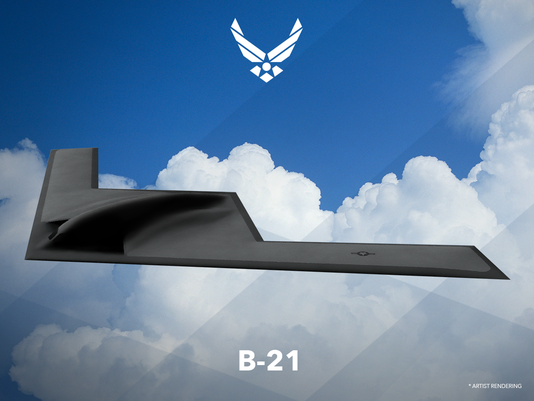
Air Force releases renderings of LRSB - designated B-21.

ORLANDO, Fla. — The US Air Force secretary unveiled the first official rendering of the new Long Range Strike Bomber and revealed its official designation: the B-21.

In a speech at the Air Force Association's Air Warfare Symposium on Feb. 26, Secretary Deborah Lee James shared an artist's concept design of the next-generation bomber, which will be built by Northrop Grumman. She also announced the plane's long-awaited designation, calling it the B-21.
However, the Air Force still has not decided on a name for the new B-21, James said. She called on airmen to send in suggestions.

"So we have an image, we have a designation, but what we don't yet have, we don't yet have a name," James said, "and this is where I'm challenging and I'm calling on every airman today ... to give us your best suggestions for a name for the B-21, America's newest bomber."


Northrop Grumman spokesman Tim Paynter stressed the B-21 bomber's importance to the nation's future in a statement emailed to reporters following James' remarks.

“Northrop Grumman is proud to serve as the prime contractor for the B-21 Bomber, in partnership with the U.S. Air Force, to deliver a capability that is vital to our national security," Paynter said. “Any further questions should be directed to the Air Force.”

The Air Force awarded the contract for B-21 engineering, manufacturing and development to Northrop on Oct. 27. The service plans to field the new bomber in the mid-2020s.

Monday, February 1, 2016

UCLASS to become a unmanned aerial tanker.

The Navy’s Unmanned Carrier Launched Airborne Surveillance and Strike (UCLASS) effort is being retooled as primarily a carrier-based unmanned aerial refueling platform as part of several Pentagon naval aviation mandates as part if the the service’s Fiscal Year 2017 budget submission, USNI News has learned.

The shift from UCLASS to the new Carrier Based Aerial Refueling System (CBARS) will be made alongside an additional buy of Boeing F/A-18 E/F Super Hornets over the next several years and accelerated purchases and development of the Lockheed Martin F-35 Lighting II Joint Strike Fighter (JSF).

The trio of budget moves seeks to blunt the Navy’s looming strike fighter shortfall, move more stealth capability sooner into the carrier air wing and create a development path for future unmanned systems onboard the service’s fleet of nuclear carriers, according to the rationale the Pentagon put forth to the service several defense officials told USNI News.

The budget submission – in part informed by the Pentagon’s UAV strategic program review (SPR) led by Deputy Secretary of Defense Bob Work – will also include 15 F-35C JSFs in 2017 and plan for an additional 14 Super Hornets in FY18, USNI News undersatnds.

“That study found that you need a mix of all of these things,” a defense official told USNI News on Monday.

USNI News understands there may also be efforts to accelerate developments of the Block 3F JSF software – now slated to reach initial operational capability in August 2018 and the major barrier for the Navy to regularly deploy F-35Cs.

The revelation of the budget mandates also comes mere days after the Navy kicked off the Analysis for Alternatives for its next generation air dominance platform – also known as F/A-XX. The program or programs that will replace the capability of the Super Hornets in the early 2030s.

Last year, Secretary of the Navy Ray Mabus said the F-35C would be “almost certainly will be, the last manned strike fighter aircraft the Department of the Navy will ever buy or fly,” he said in address at the Navy League’s 2015 Sea-Air-Space Exposition.

Mabus later said UCLASS was to act as the bridge to autonomous unmanned strike platforms and predicted “whatever F/A-XX looks like — it should be unmanned,” he said in May.

LinkWithin

Blog Widget by LinkWithin