Monday, May 19, 2025

First B61-13, the latest nuclear gravity bomb, nearly a year ahead of schedule.


AMARILLO, Texas (KVII) — The Pantex Plant in Amarillo completed the first B61-13, the latest nuclear gravity bomb, nearly a year ahead of schedule.

U.S. Secretary of Energy Chris Wright stamped the bomb during a ceremony on Monday.

“Modernizing America’s nuclear stockpile is essential to delivering President Trump’s peace through strength agenda,” said Secretary of Energy Chris Wright. “The remarkable speed of the B61-13’s production is a testament to the ingenuity of our scientists and engineers and the urgency we face to fortify deterrence in a volatile new age."

The B61 is the longest-serving and most versatile weapon in the U.S. nuclear stockpile.


While the B61 family can be delivered by a broad range of fighter and bomber aircraft, the B61-13 will only be certified for delivery by strategic bomber aircraft and deployed from bases in the continental United States.

“Accelerating production of the B61-13 while maintaining the highest standards of safety and security, and without disrupting our other six modernization programs, is a remarkable achievement,” said David Hoagland, Acting Deputy Administrator for Defense Programs.

The entire project is expected to be finished in 2027.


Wednesday, March 5, 2025

B-52 possibly carrying Lockheed's AGM-183 spotted over Texas.


A B-52 flying from Barksdale AFB to Dugway proving grounds in Utah was photographed over Texas with what looks like might be a Lockheed AGM-183 hypersonic missile. Flight tracks showed it possibly launched from Barksdale, AFB in Louisiana,

The AGM-183 ARRW ("Air-Launched Rapid Response Weapon") is a hypersonic air-to-ground ballistic missile planned for use by the United States Air Force

Developed by Lockheed Martin, the boost-glide vehicle is propelled to a maximum speed of more than Mach 5 by a rocket motor before gliding toward its target. The program was cancelled in March 2023 after multiple failed tests. 

The program, however, continued despite the cancellation and was announced to still be in development following additional, undisclosed testing. However in 2024 it was announced that in the fiscal year 2025 budget, no funding would be provided for procurement or further research and development.

The AGM-183A had a claimed maximum speed of more than 15,000 miles per hour (24,000 km/h; Mach 20[disputed (for: disagreement between sources. 

The weapon used a boost-glide system, in which it was propelled to hypersonic speed by a rocket on which it was mounted before gliding toward a target.

According to Popular Mechanics, the U.S. Air Force was, as of April 2020, considering using the remaining fleet of B-1B bombers as AGM-183A firing platforms, with each aircraft carrying up to 31 hypersonic weapons (between ARRW and HAWC) mounted on the Common Strategic Rotary Launcher and on external pylons.

On March 17, 2024, the USAF conducted its final planned end-to-end test launch of the AGM-183A, successfully launching one out of a B-52 bomber taking off from Andersen Air Force Base. According to a USAF statement issued on 20 March. “The Air Force gained valuable insights into the capabilities of this technology,” the statement added without giving further details, including whether the test was deemed a success

On March 29, 2023, Assistant Secretary of the Air Force for Acquisition, Technology and Logistics, Andrew Hunter told the House Tactical Air and Land Forces Subcommittee, a committee responsible for providing oversight for military ammunition, acquisition, and aviation programs, that the AGM-183A program would not proceed, although the ARRW program's last two all-up round test flights would proceed in order to collect data to help with future hypersonic programs.[8] In the Fiscal Year 2025 budget, released March 11, 2024, no funding was provided for procurement or further research and development of the AGM-183, effectively ending the project, but with this new possible sighting over Texas (not yet confirmed) it may be that testing and (or) fielding of the weapon may have resumed.

Russia is developing at least three hypersonic weapons that are operational or approaching operational status. These systems, introduced by Russian President Vladimir Putin in his 2018 and 2019 speeches to the Federal Assembly, address requirements for Russian regional and strategic strike capabilities, and all are capable of carrying nuclear warheads. While these systems could pose problems for U.S. and NATO defense planning, their introduction in the near-term is not likely to fundamentally alter the existing balance of power or the prospects for strategic stability.

Flying in broad daylight and easily photographed, the sighting may have been a subtle way to let Russia know that U.S. hypersonic missile tests are proceeding. The aircraft appears to be B-52H 61-0028 as featured on The Aviationist. LINK


(C) Steve Douglass webbfeat@gmail.com 

enhanced (C) Steve Douglass 


(C) Steve Douglass webbfeat@gmail.com 


Thursday, January 30, 2025

WAPO: What we know about the plane and military helicopter crash in D.C.


By Kelly Kasulis Cho,

Helier Cheung and Tobi Raji WAPO


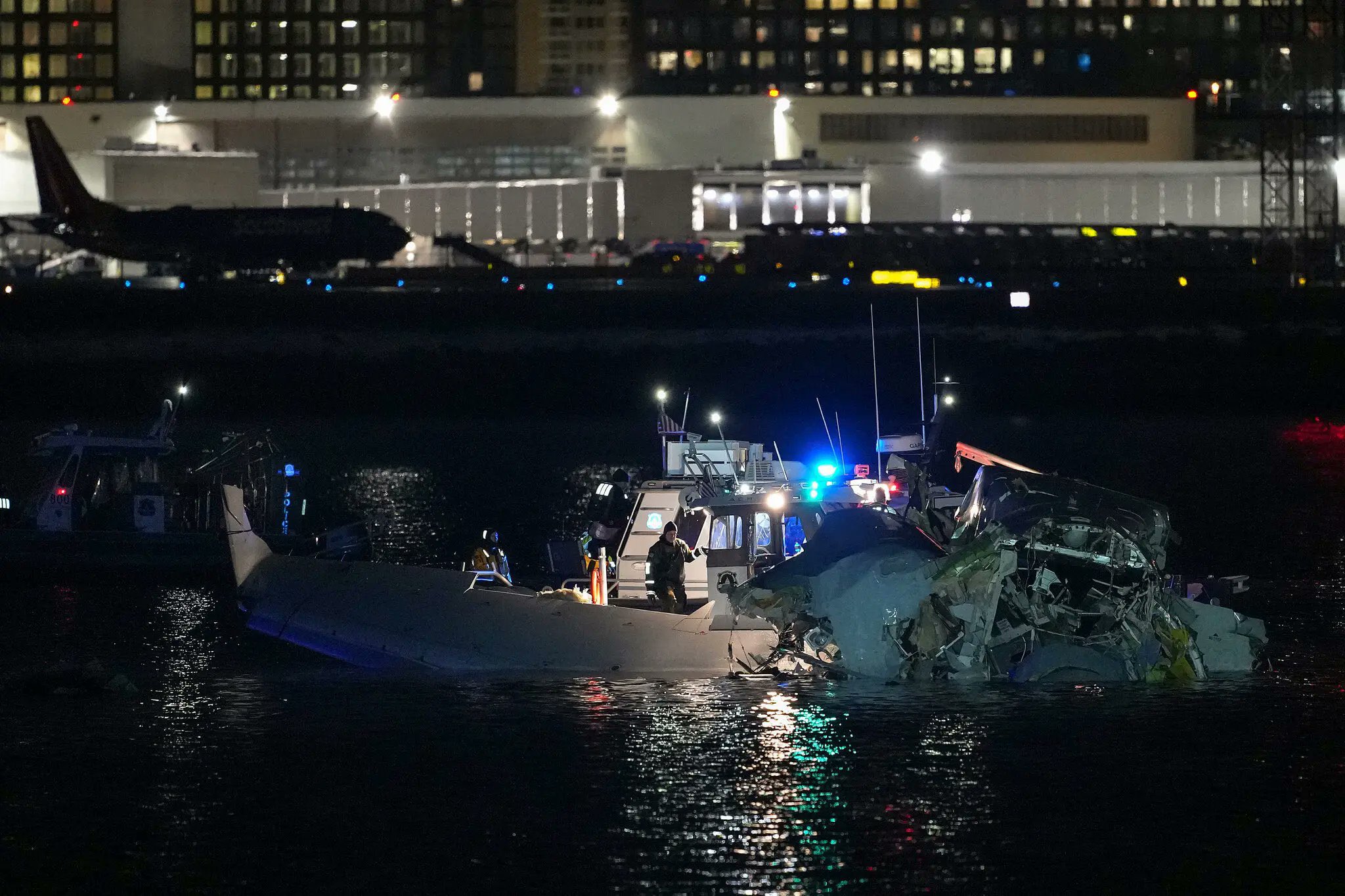
An American Airlines plane and an Army Black Hawk helicopter collided in midair near Reagan National Airport on Wednesday night. Both aircraft crashed into the Potomac River in Washington. Police had pulled 28 bodies from the water as of Thursday morning, according to officials, who believe all passengers and crew aboard the airplane were killed. National Airport reopened to air traffic Thursday morning.

Here’s what we know about the crash so far.

The crash:
American Airlines said 60 passengers and four crew members were aboard American Eagle Flight 5342 from Wichita. The flight — a Bombardier CRJ700 regional jet operated by American Airlines subsidiary PSA Airlines — was set to land in Washington at 8:57 p.m., according to aircraft tracker FlightAware. All are believed to have died in the crash.


The plane and an Army UH-60 Black Hawk helicopter that was on a training flight collided at 8:47 p.m., according to publicly available flight-tracking data. The helicopter was from the 12th Aviation Battalion at Fort Belvoir in Virginia, Defense Secretary Pete Hegseth said in a video posted Thursday morning.

The military helicopter was found upside down in the water and the plane had broken into pieces, according to a D.C. official who spoke on the condition of anonymity because they were not authorized to speak publicly.
Weather around the time of the incident was not out of the ordinary. National Airport reported clear skies, visibility of 10 miles and winds sustained from the northwest at 16 mph, gusting to 26 mph. The temperature was 50 degrees.

The victims
About 20 members of the U.S. Figure Skating community were aboard the American Airlines jet, according to a person professionally involved in the sport who spoke on the condition of anonymity to discuss a sensitive matter. Athletes, coaches and family members were returning home from the National Development Camp held in conjunction with the U.S. Figure Skating Championships in Wichita.

Four D.C.-area steamfitters were also aboard the jet, the United Association of Union Plumbers, Pipefitters and Steamfitters Local 602 said in a statement Thursday morning. The four were members of Steamfitters Local 602 — a Prince George’s County, Maryland-based union that represents steamfitters and pipe fitters in the D.C. area.

The Association of Flight Attendants, which represents cabin crews at PSA Airlines, said in a statement that two flight attendants were on board the plane.
The military is withholding the identities of the soldiers aboard the helicopter because it has not yet notified all surviving family members, Hegseth said Thursday morning, describing the crew as “fairly experienced.” No senior U.S. leaders were aboard the Black Hawk, two defense officials said, speaking on the condition of anonymity because of the sensitivity of the matter

Recovery and investigation efforts

The National Transportation Safety Board is leading an investigation into the incident, with help from the Federal Aviation Administration. On Thursday, President Donald Trump tapped Chris Rocheleau, chief operating officer of the National Business Aviation Association, as the FAA’s acting administrator.
All passengers and crew aboard the plane are presumed dead, officials said. Police had pulled 28 bodies from the water, Donnelly said Thursday morning: 27 from the plane and one from the helicopter.
The Army unit involved in the training flight — the 12th Aviation Battalion at Fort Belvoir in Virginia — has paused operations for 48 hours, Hegseth said. The Defense Department is investigating the incident.

The Coast Guard, Maryland State Police, Metro Transit Police and Maryland Department of Natural Resources have been deployed to the scene. Dive teams from Prince George’s County have also pitched in. D.C. Fire and EMS Chief John A. Donnelly Sr. said he expects operations at the crash site to continue for days, and that the weather is “extrmely rough for the responders.”
The temperature hovered 50 degrees Thursday during the day with light winds — a stark change from Wednesday, when it reached 64 degrees with blustery winds. Water temperatures in the Potomac are in the mid-30s.

Crews found debris as far south as the Woodrow Wilson Bridge, about a mile from the crash, Donnelly said Thursday morning. Nearby National Harbor has been closed to assist search and recovery efforts, acting Prince George’s County Executive Tara Jackson said Thursday morning in a post on X.
Transportation Secretary Sean P. Duffy said Thursday morning that “everything was standard in the lead-up to the crash” but “obviously, something happened here” to cause the plane and helicopter to collide. “Something went wrong here,” he said, adding that he hopes to release more information later. “Do I think this was preventable? Absolutely,” he added.

During a news conference Thursday, Trump first pinned the deadly collision on air traffic control, saying “the warnings were given very very late” and that “it should have been brought up earlier.” He also said without evidence that diversity hiring “could have” cause the crash. The president also criticized those in the Black Hawk helicopter: “The people in the helicopter should have seen where they were going,” he said. “I can’t imagine people with 20-20 vision not seeing what’s happening up there.”
Direct flights from Wichita to National Airport started just over a year ago, according to Jesse Romo, the director of airports for the Wichita Airport Authority.
The crash follows a string of close calls at National and other airports, beginning in early 2023, that alarmed officials and the airline industry. It is likely to renew debate over safety and whether the airport is at capacity.

Airline information.

In a video message, American Airlines CEO Robert Isom said that the company has set up a helpline for people who think friends or family members might have been on board the flight.
The airline said those who think they might have had loved ones on the flight should call American Airlines at 800-679-8215. Individuals calling from outside the United States can visit news.aa.com for additional phone numbers. Family members in Canada, Puerto Rico or the U.S. Virgin Islands can call 800-679-8215 directly.
National Airport reopened to air traffic at 11 a.m. Thursday. The airport said all terminals are open and travelers should check with their airlines because some flights have been delayed or canceled.

Monday, January 27, 2025

Three B-21 Raiders now in flight testing.


According to information published on the X Account of AirPower 2.0 (MIL_STD), on December 31, 2024, the United States Air Force's next-generation stealth bomber, the B-21 Raider, is making significant progress in its development with three aircraft actively supporting the bomber's flight test campaign. Northrop Grumman, the defense contractor behind this cutting-edge platform, has announced key updates as part of the effort to validate the Raider’s capabilities.

The B-21 Raider’s are conducting a combination of flight and ground testing to ensure the program remains on track for future operational deployment. This milestone underscores the steady advancement of the B-21 program, which is regarded as a cornerstone of the U.S. Air Force's future long-range strike capabilities.

The B-21 Raider is a next-generation long-range strategic bomber designed to meet the evolving demands of modern warfare. It will replace aging platforms like the B-1 Lancer and B-2 Spirit, which have served as the backbone of the U.S. Air Force's bomber fleet for decades. The Raider embodies a host of cutting-edge technologies, making it the world’s first sixth-generation bomber. Its advanced stealth capabilities will allow it to penetrate heavily defended airspaces, while its open architecture design ensures it can seamlessly integrate emerging technologies over time. Equipped to carry both conventional and nuclear payloads, the B-21 is a critical component of the Pentagon's nuclear triad modernization efforts, ensuring the United States retains credible and adaptable deterrence capabilities in an increasingly complex global security environment.

Among its key features, the B-21 offers enhanced survivability, with stealth characteristics designed to evade advanced radar systems. It is being engineered with a modular open systems approach (MOSA), enabling rapid upgrades to avionics, sensors, and weapons systems, thus keeping it operationally relevant for decades. Its extended range and payload capacity will provide the Air Force with unmatched versatility, allowing it to conduct a variety of missions ranging from global strikes to intelligence, surveillance, and reconnaissance (ISR). Additionally, the B-21 will be capable of operating in high-threat environments and is expected to offer an unprecedented degree of reliability and maintainability compared to its predecessors.

Currently, the first B-21 Raider, known as T-1, is undergoing flight testing at Edwards Air Force Base (AFB). These tests are essential for evaluating the bomber’s aerodynamic performance, stealth capabilities, and advanced avionics systems in real-world conditions. Meanwhile, two additional B-21 aircraft are engaged in ground-based testing, including structural integrity tests and systems integration tests to ensure the compatibility and functionality of the onboard technologies and weapons delivery capabilities.

Looking ahead, the program is set to accelerate as three more B-21 Raiders are scheduled to join the flight test campaign in the near future. These additional aircraft will enable simultaneous testing across multiple domains, helping to validate the bomber's performance under diverse operational scenarios. This expansion reflects a methodical approach to addressing technical challenges while maintaining a schedule that aligns with the Air Force’s modernization objectives.

As the testing campaign continues, the program remains a focal point for the defense community, given its potential to redefine aerial warfare. The successful integration of new technologies into the B-21 will not only shape U.S. Air Force capabilities but also serve as a benchmark for future military aviation programs.

Wednesday, January 22, 2025

Trump announces America seeks to be at forefront of A.I. technology with "Operation Stargate"


On the second day of his presidency, Donald Trump announced billions of dollars worth of investment to build artificial intelligence infrastructure in the United States of America. Trump said that three big players in the private sector—OpenAI, Softbank, and Oracle—are planning a joint venture called Stargate.

President Trump was joined by OpenAI CEO Sam Altman, Softbank CEO Masayoshi Son, and Oracle CEO Larry Ellison. Trump said that Stargate will invest at least $500 billion into AI infrastructure in the US, creating over 100,000 American jobs almost immediately.


“This monumental undertaking is a strong vote of confidence in America’s future and leadership under this administration. This project ensures that the United States will remain the global leader in AI and technology, rather than letting competitors like China gain the edge,” Trump said.

The Stargate Project is essentially a new company that aims to invest $500 billion towards building advanced AI infrastructure in the US over the next four years. The initiative will invest $100 billion almost immediately. This ambitious project seeks to push American AI leadership, create hundreds of thousands of jobs, and provide significant global economic benefits.

The project backs US re-industrialization and enhances national security capabilities. Softbank, Oracle, OpenAI, and MGX are the key stakeholders, with Softbank handling the financial aspect and OpenAI overseeing the operations. Masayoshi Son will be the chairman, and the technology partners include Arm, Microsoft, NVIDIA, Oracle, and OpenAI.

When it comes to physical infrastructure, the construction has begun in Texas, with plans to expand to other locations in the US. Project Stargate aims to drive the development of artificial general intelligence (AGI). This project is a significant leap in AI’s progress.

Many details about the Stargate Project are still under wraps. OpenAI has posted a general outline on its official website; however, more information about this ambitious project is expected to be announced in the coming days.


LinkWithin

Blog Widget by LinkWithin