Sunday, May 17, 2020

Sneak Peek: Author Jim Goodall's pictorial book on 75th Anniversary of Lockheed's Skunkworks slated for 2021 release:

Dear friends,

Author and fellow interceptor Jim Goodall (AKA The Great One) has kindly granted DeepBlackHorizon a sneak peak at some of the proofs from his forthcoming book 75 Years of the Lockheed Skunkworks.  

Jim was given unprescedented access to Lockheed files for a look deep inside the black history of one of the most secretive military aviation contractors in the world.  Due out in 2021 (delayed a tad by the COVID 19 outbreak) this much anticipated book promises never before seen photos, history and technical details coming from the geniuses that brought us the U-2, SR-71 Blackbird, F-117 Stealth fighter, not to mention the F-22 and F-35.  

But that's not all. 

Jim writes: "Here are a handful of pages without any text for my up coming “Pictorial History of the First 75 Years of the Lockheed Martin Skunk Works” due out in 1Q21. It has over 300 photographs from the Lockheed files, many that have never been published before and  also after waiting over two years, my second volume of my three part series on the US Navy’s fleet of submarines arrived today for my publisher. 

The pictorial covers two classes of SSNs, the Seawolf and the Virginia class SSNs. The book is in full color, 176 pages, landscape format and hardbound. In addition to the Seawolf and Virginia class SSNs, I cover the NR-1 and the Tenders. 

I’ve been told that it will be about six to eight weeks before copies arrive at Amazon and your local books stores."

Thanks Jim! 


click to enlarge all images (C) Jim Goodall 


Tuesday, February 11, 2020

Aerojet Rocketdyne awarded Glide Breaker hypersonic defense interceptor project.


HUNTSVILLE, Ala., Feb. 10, 2020 (GLOBE NEWSWIRE) -- Aerojet Rocketdyne has been awarded a contract worth up to $19.6 million by the Defense Advanced Research Projects Agency (DARPA) to develop enabling technologies for an advanced hypersonic defense interceptor known as Glide Breaker.

Advancing hypersonic technology is a national security imperative,” said Eileen Drake, Aerojet Rocketdyne CEO and president. “Our team is proud to apply our decades of experience developing hypersonic and missile propulsion technologies to the Glide Breaker program.”

According to DARPA, the Glide Breaker program intends to advance the United States’ means to counter hypersonic vehicles. The effort aims to develop and demonstrate a technology that is critical for enabling an advanced interceptor capable of engaging maneuvering hypersonic threats in the upper atmosphere.

Aerojet Rocketdyne supplies both solid-fueled and air-breathing propulsion systems for hypersonic flight. The company provided both types of systems for the joint Air Force-DARPA-NASA X-51A WaveRider, which completed the first practical hypersonic flight of a hydrocarbon-fueled and -cooled scramjet-powered vehicle. More recently, the company successfully completed a series of subscale propulsion-system test firings as part of DARPA’s Operational Fires (OpFires) program, which is an effort to develop a ground-launched hypersonic missile for tactical use.

Friday, January 31, 2020

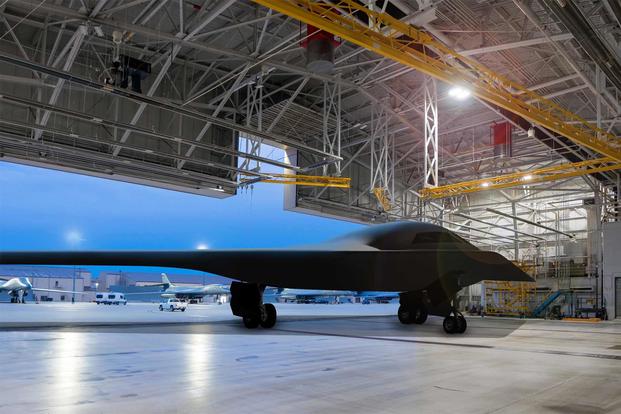
Air Force releases new B-21 rendering ..


click to enlarge


MILITARY.COM 

New photorealistic renderings of the B-21 Long Range Strike Bomber have officially landed.

The Air Force together with the bomber's manufacturer, Northrop Grumman, published three new concepts of the next-generation bomber, showing the stealth aircraft in various hangars at bomber bases across the U.S.


One shows a concept of the B-21 tucked away in a hangar at Ellsworth Air Force Base, South Dakota, currently a B-1B Lancer base; a second shows the aircraft at Whiteman Air Force Base, Missouri, which currently houses the B-2 Spirit; and a final photo presenting the B-21 at Dyess Air Force Base, Texas, also a B-1 base.

Last year, the service announced the B-21's first operational base would be at Ellsworth and would also host the bomber's first formal training unit. Whiteman and Dyess are expected to receive B-21 Raiders "as they become available," the service said at the time.

Related: With B-1 Aging and B-21 Still Years Out, Air Force May Soon Have No Go-To Bomber

The B-21 is still years away. Officials have said first deliveries should begin in the mid-2020s, but have been careful not to broadcast too many other details in order to protect details about the B-21's technology.
This is an artist rendering of a B-21 Raider concept in a hangar at Ellsworth Air Force Base, S.D. Ellsworth AFB is one of the bases expected to host the new airframe. (Courtesy graphic by Northrop Grumman)

While enthusiasts have compared the squat, sleek profile of the B-21 to the B-2 stealth bomber -- also developed by Northrop -- a specialist for military aviation at the Congressional Research Service was quick to point out one potential difference.

Altering the photo's contrast, "it becomes evident that what looks like the 'beak' is the port leading edge. The nose (as depicted) is not as sharp as B-2," Jeremiah "JJ" Gertler tweeted Friday.

The Air Force plans to buy roughly 100 bombers, but could end up purchasing more depending on the service's needs.

Officials are conveying the program's planned milestones and schedule of events to lawmakers on congressional defense committees, as well as top brass at the Pentagon. In August, Vice Chief of Staff Gen. Stephen "Seve" Wilson said he's counting the days until the bomber's first flight in December 2021.

In 2016, the Air Force announced it would name its next-generation LRS-B the Raider after the service's legendary Doolittle Raiders. The late World War II veteran Richard E. Cole, the last surviving Doolittle Raider, made the announcement that year.

The Air Force awarded Northrop the contract, initially worth $21.4 billion, in 2015. Total costs are expected to exceed $55 billion over the life of the program.

Monday, January 27, 2020

E-11A surveillance aircraft crashes in Afghanistan


KABUL, Afghanistan (AP) — An American military aircraft crashed in eastern Afghanistan on Monday, the U.S. military said, adding that there were no indications so far it’d been brought down by enemy fire.

The spokesman for U.S. forces in Afghanistan, Col. Sonny Leggett, said that the military plane, a Bombardier E-11A, crashed in the Ghazni province and an investigation of its causes was ongoing.

Monday’s plane crash is not expected to derail U.S.-Taliban peace talks if it turns out to have been an accident.

The Bombardier E-11A is a U.S. Air Force electronic surveillance plane. Video from the crash site circulating on social media appeared to show its charred ruins.

A Taliban spokesman and Afghan journalist affiliated with the militant group had earlier said the mystery crash was a U.S. military plane.

Tariq Ghazniwal, a journalist in the area, said that he saw the burning aircraft. In an exchange on Twitter, he told The Associated Press that he saw two bodies and the front of the aircraft was badly burned. He added that the aircraft’s body and tail were hardly damaged. His information could not be independently verified.

Ghazniwal said the crash site was about 10 kilometers (6.2 miles) from a U.S. military base. Local Taliban have been deployed to protect the crash site, he said, and several other militants were combing the nearby village for two people they suspect may have survived the crash.

The Taliban hold much of Ghazni province and have total control over the local area of the crash.

Ghazniwal said the site was near a village called Sado Khelo, in the Deh Yak district. He also said the crash occurred soon after 1 p.m. local time, but residents in the area did not report a loud crashing noise. He couldn’t say whether the aircraft had been shot down but “the crash was not loud.”

Images on social media purportedly of the crashed plane showed an aircraft bearing U.S. Air Force markings similar to other E-11A surveillance aircraft photographed by aviation enthusiasts. Visible registration numbers on the plane also appeared to match those aircraft.

The so-called Battlefield Airborne Communications Node can be carried on unmanned or crewed aircraft like the E-11A. It is used by the military to extend the range of radio signals and can be used to convert the output of one device to another, such as connecting a radio to a telephone.

Colloquially referred to by the U.S. military as “Wi-Fi in the sky,” the BACN system is used in areas where communications are otherwise difficult, elevating signals above obstacles like mountains. The system is in regular use in Afghanistan.

The U.S. and Taliban are negotiating a reduction in hostilities or a cease-fire to allow a peace agreement to be signed that could bring home an estimated 13,000 American troops and open the way to a broader post-war deal for Afghans. The Taliban currently control or hold sway over around half the country.

Local Afghan officials had said earlier on Monday that a passenger plane from Afghanistan’s Ariana Airlines had crashed in the Taliban-held area of the eastern Ghazni province. However, Ariana Airlines told The Associated Press that none of its planes had crashed in Afghanistan.

The conflicting accounts could not immediately be reconciled.

Arif Noori, spokesman for the provincial governor, said the plane went down around 1:10 p.m. local time (8:40 a.m. GMT) in Deh Yak district, some 130 kilometers (80 miles) southwest of the capital Kabul. He said the crash site is in territory controlled by the Taliban. Two provincial council members also confirmed the crash.

But the acting director for Ariana Airlines, Mirwais Mirzakwal, dismissed reports that one the company’s aircraft had crashed. The state-owned airline also released a statement on its website saying all its aircraft were operational and safe.

The mountainous Ghazni province sits in the foothills of the Hindu Kush mountains and is bitterly cold in winter.

Gannon reported from Islamabad. Associated Press writers Jon Gambrell, Aya Batrawy and David Rising contributed to this report from Dubai, United Arab Emirates; Tameem Akhgar from Kabul, Afghanistan, and Robert Burns from Washington.

LinkWithin

Blog Widget by LinkWithin