Friday, February 9, 2018

Russian's caught mining for cryptocurrency using nuke lab's supercomputer..

ARS TECHNICA;  Russia's Interfax News Agency reports that engineers at the All-Russian Research Institute of Experimental Physics (RFNC-VNIIEF)—the Russian Federation Nuclear Center facility where scientists designed the Soviet Union's first nuclear bomb—have been arrested for mining cryptocurrency with "office computing resources," according to a spokesperson for the Institute. "There has been an unsanctioned attempt to use computer facilities for private purposes including so-called mining," said Tatyana Zalesskaya, head of the Institute's press service.

Zalesskaya did not say how many people were detained, and the Federal Security Service (FSB) has not issued a statement on the arrests or criminal charges pending. But reports indicate that the group was caught trying to harness the lab's supercomputer to mine cryptocurrency.

The Institute is located in Sarov, a "closed" city east of Moscow where nuclear weapons research has been conducted since 1946. The facility is so secret that it was left off Soviet maps; Sarov is surrounded by fences and guarded by the Russian military accordingly. While the city is the home of Russia's Nuclear Weapons Museum, don't plan a visit anytime soon—access to Sarov is restricted, and no one who does not live in the city is allowed to visit without permission. Foreigners visiting on official business have to surrender their passports, cell phones, and other electronic devices at the city's checkpoints.
Because of the nature of the work at the Institute, technically none of the Institute's computers—including its 1-petaflop capable supercomputer, used for simulating tests of nuclear weapons designs—is supposed to be connected to the Internet. According to the Russian news service Mash, someone at the Institute attempted to connect the supercomputer to the Internet, and that attempt was detected by the FSB, launching an investigation.

Cryptocurrency speculation and mining have generated so much interest in Russia that one businessman—Alexey Kolesnik—recently bought two power plants in the Russian republics of Perm Krai and Udmurtia to be used exclusively to generate electricity for Bitcoin-mining data centers. But there have been numerous other attempts recently in Russia to harness corporate and industrial computer systems for illicit cryptocurrency mining as well.

Tuesday, February 6, 2018

SpaceX launches most powerful rocket in decades...


NPR: The world's newest, most powerful rocket in decades has reached space. It took a few weather delays Tuesday, but the private space company SpaceX successfully launched its Falcon Heavy rocket from the Kennedy Space Center.

Watch the video of the launch at the here. (If you'd like to skip ahead to the very moment the rocket lifts off, you can find it about 29:50 into the video.)

Not long after the massive craft blasted off NASA's historic Launch Pad 39A, arcing a fiery path through the sky, its side boosters fell away. As the main rocket continued its journey into space, two of the boosters returned to Earth, landing successfully back on their designated pads.

UN investigating reports of alleged chlorine attack in Syria


(CNN)

United Nations human rights experts said Tuesday they were investigating reports of alleged chlorine bomb attacks on civilians in two Syrian towns.

"Most alarmingly, the commission has received multiple reports, now under investigation, that bombs allegedly containing weaponized chlorine have been used in the town of Saraqeb in Idlib and in Douma in Eastern Ghouta," near Damascus, Paulo Pinheiro, chair of the UN's commission of inquiry on Syria, said in a statement issued in Geneva.

The panel also expressed "deep concerned" over the escalation of violence in rebel-held Idlib province and in Eastern Ghouta, Pinheiro said.

The White Helmets, a volunteer rescue group, said three of its members and six others were injured by chlorine gas attack in Idlib's Saraqeb on Sunday night. The group posted several videos on social media showing men coughing and being put onto stretchers.

Two media activists who spoke to CNN from the nearby town of Kafranbil said they were told that the chlorine attack in Saraqeb had been launched from Syrian helicopters.

Tuesday, January 9, 2018

Was TOP SECRET ZUMA satellite lost in space?


THE SLATE:

SpaceX launched a rocket in Florida on Sunday carrying a secret military satellite dubbed “Zuma,” which was likely worth billions of dollars. The mission has been largely shrouded in secrecy—everything from the purpose of the payload to the identity of the government department that commissioned it is classified. And now, in the days after the launch, the public has been kept in the dark about what happened to the satellite. All we really know is that something went wrong.

Various news outlets are reporting that the satellite, built by Northrop Grumman and reportedly belonging to the United States, is now lost because it did not detach as planned from the Falcon 9 rocket and thus failed to reach orbit.

However, because the mission was classified, accounts of the bungled mission have conflicted about what exactly occurred. Even the livestream of the launch offers few answers, because SpaceX cut the broadcast before the satellite’s separation from the rocket to maintain a level of confidentiality.


The Wall Street Journal’s is reporting, based on interviews with industry and government sources, that the satellite was dragged back down into atmosphere when it didn’t separate properly from the upper part of the rocket, either due to problems with the timing of the release or damage to the payload. Members of Congress and staffers were then briefed on the situation. The report, however, acknowledges the murky nature of the events and contains a caveat: “The lack of details about what occurred means that some possible alternate sequence of events other than a failed separation may have been the culprit.”

Spokespersons for the companies involved offered the Journal very little by way of on-the-record information. Northrop Grumman did not provide a comment due to the “classified” nature of the launch, and a spokesman from SpaceX told the Journal, “We do not comment on missions of this nature, but as of right now reviews of the data indicate Falcon 9 performed nominally.”

Bloomberg cited a U.S. official and two congressional aides in its account of what went wrong, which is roughly the same as the Journal’s.
One of the aides told the reporters that the satellite was lost, while another claimed that it crashed into the sea.

Yet, SpaceX’s chief operating officer Gwynne Shotwell gave Bloomberg an even stronger statement concerning the success of the operation, which reads, “After review of all data to date, Falcon 9 did everything correctly on Sunday night. If we or others find otherwise based on further review, we will report it immediately.” She added that “no design, operational or other changes are needed.”

READ MORE HERE


UPDATE: TESLARATI

After some 24 hours of total silence from all parties involved, dubious rumors began to trickle out on the afternoon of January 8 suggesting that SpaceX’s launch of Northrop Grumman’s highly secretive Zuma payload had somehow failed. Without hesitation, otherwise reputable outlets like CNBC and the Wall Street Journal immediately published separate articles claiming that lawmakers had been updated about the mission and told that the satellite had been destroyed while reentering Earth’s atmosphere. Having completely failed to both make it to orbit and “perfectly” separate from SpaceX’s Falcon 9 second stage, these articles implicitly placed the blame on SpaceX.

Claims of Zuma’s failure to properly separate from the second stage of the rocket led immediately to suggestions that SpaceX was at fault. The satellite’s manufacturer, Northrop Grumman, also refused to comment due to the classified nature of the mission, and the company may well have had their hands tied by requirements of secrecy from their customer(s). Immediately following these quick revelations, SpaceX was understandably bombarded with requests for comment by the media and furnished a response that further acknowledged the off-limits secrecy of the mission. However, SpaceX also stated that the company’s available data showed that Falcon 9 completed the mission without fault.

Without any background knowledge of spaceflight, this flurry of reporting and corporate comments would seem to be perfectly reasonable and unsurprising. However, the barest application of simple logic and orbital mechanics (what is actually involved in launching satellites to orbit) would have almost completely invalidated the information purportedly given to them.

Around the same time as claims of complete failure and satellite reentry were published, amateur spy satellite trackers had already begun the routine task of tracking and cataloging Zuma’s launch and orbit. 

Following Ars Technica’s breaking (and thankfully even-keeled) article on whispers of failure, reputable journalist Peter B. de Selding corroborated the rumors with reports that Zuma could be dead in orbit after separation from SpaceX’s upper stage. These facts alone ought to have stopped dead any speculation that Zuma had reentered while still attached to the Falcon 9 upper stage, and this was strengthened further by Dr. Marco Langbroek, who later published images provided to him that with very little doubt showed the second stage in a relatively stable orbit similar to the orbit that might be expected after a nominal launch.

While current information almost unequivocally suggests that SpaceX is in the clear, there has yet to be any official confirmation that the Zuma satellite is in any way dead or has actually failed. This is par for the course of classified government launches, and Zuma’s launch campaign was even more secretive and eccentric than usual – we still have no idea what government agency or agencies are responsible for the mission. And the satellite’s manufacturer was explicitly provided only a few minutes before its launch. Any publication with experience dealing with military topics and news would explicitly understand that any ‘leaked’ information on highly classified topics is inherently untrustworthy and ought to be handled with the utmost rigor and skepticism.

Wednesday, December 27, 2017

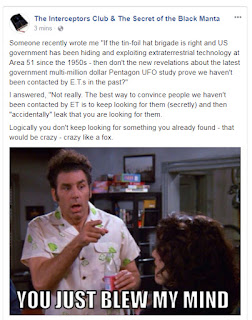
Do new revelations about latest Pentagon UFO study rule out extraterrestrial contact in the past?

cick to read more


WASHINGTON — In the $600 billion annual Defense Department budgets, the $22 million spent on the Advanced Aerospace Threat Identification Program was almost impossible to find.

Which was how the Pentagon wanted it.

For years, the program investigated reports of unidentified flying objects, according to Defense Department officials, interviews with program participants and records obtained by The New York Times. It was run by a military intelligence official, Luis Elizondo, on the fifth floor of the Pentagon’s C Ring, deep within the building’s maze.

The Defense Department has never before acknowledged the existence of the program, which it says it shut down in 2012. But its backers say that, while the Pentagon ended funding for the effort at that time, the program remains in existence. For the past five years, they say, officials with the program have continued to investigate episodes brought to them by service members, while also carrying out their other Defense Department duties.

The shadowy program — parts of it remain classified — began in 2007, and initially it was largely funded at the request of Harry Reid, the Nevada Democrat who was the Senate majority leader at the time and who has long had an interest in space phenomena. Most of the money went to an aerospace research company run by a billionaire entrepreneur and longtime friend of Mr. Reid’s, Robert Bigelow, who is currently working with NASA to produce expandable craft for humans to use in space.

On CBS’s “60 Minutes” in May, Mr. Bigelow said he was “absolutely convinced” that aliens exist and that U.F.O.s have visited Earth.

Working with Mr. Bigelow’s Las Vegas-based company, the program produced documents that describe sightings of aircraft that seemed to move at very high velocities with no visible signs of propulsion, or that hovered with no apparent means of lift.Continue reading the main story

Officials with the program have also studied videos of encounters between unknown objects and American military aircraft — including one released in August of a whitish oval object, about the size of a commercial plane, chased by two Navy F/A-18F fighter jets from the aircraft carrier Nimitz off the coast of San Diego in 2004.

Mr. Reid, who retired from Congress this year, said he was proud of the program. “I’m not embarrassed or ashamed or sorry I got this thing going,” Mr. Reid said in a recent interview in Nevada. “I think it’s one of the good things I did in my congressional service. I’ve done something that no one has done before.”

Two other former senators and top members of a defense spending subcommittee — Ted Stevens, an Alaska Republican, and Daniel K. Inouye, a Hawaii Democrat — also supported the program. Mr. Stevens died in 2010, and Mr. Inouye in 2012.

While not addressing the merits of the program, Sara Seager, an astrophysicist at M.I.T., cautioned that not knowing the origin of an object does not mean that it is from another planet or galaxy. “When people claim to observe truly unusual phenomena, sometimes it’s worth investigating seriously,” she said. But, she added, “what people sometimes don’t get about science is that we often have phenomena that remain unexplained.”

READ THE REST HERE

LinkWithin

Blog Widget by LinkWithin