Friday, February 26, 2016

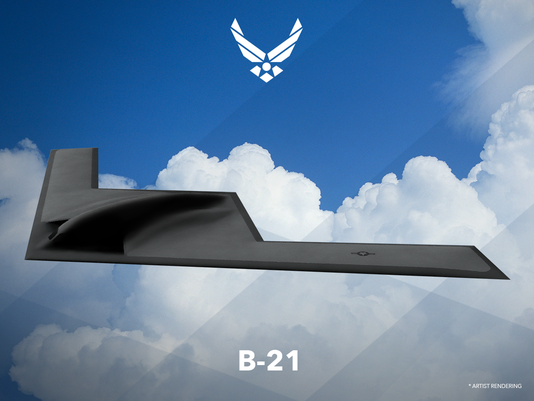
Air Force releases renderings of LRSB - designated B-21.

ORLANDO, Fla. — The US Air Force secretary unveiled the first official rendering of the new Long Range Strike Bomber and revealed its official designation: the B-21.

In a speech at the Air Force Association's Air Warfare Symposium on Feb. 26, Secretary Deborah Lee James shared an artist's concept design of the next-generation bomber, which will be built by Northrop Grumman. She also announced the plane's long-awaited designation, calling it the B-21.
However, the Air Force still has not decided on a name for the new B-21, James said. She called on airmen to send in suggestions.

"So we have an image, we have a designation, but what we don't yet have, we don't yet have a name," James said, "and this is where I'm challenging and I'm calling on every airman today ... to give us your best suggestions for a name for the B-21, America's newest bomber."


Northrop Grumman spokesman Tim Paynter stressed the B-21 bomber's importance to the nation's future in a statement emailed to reporters following James' remarks.

“Northrop Grumman is proud to serve as the prime contractor for the B-21 Bomber, in partnership with the U.S. Air Force, to deliver a capability that is vital to our national security," Paynter said. “Any further questions should be directed to the Air Force.”

The Air Force awarded the contract for B-21 engineering, manufacturing and development to Northrop on Oct. 27. The service plans to field the new bomber in the mid-2020s.

Monday, February 1, 2016

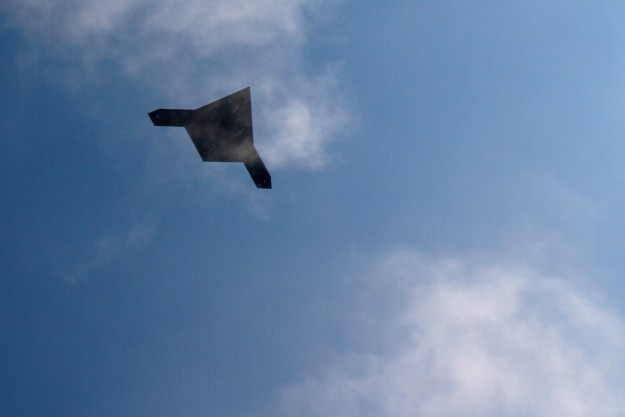
UCLASS to become a unmanned aerial tanker.

The Navy’s Unmanned Carrier Launched Airborne Surveillance and Strike (UCLASS) effort is being retooled as primarily a carrier-based unmanned aerial refueling platform as part of several Pentagon naval aviation mandates as part if the the service’s Fiscal Year 2017 budget submission, USNI News has learned.

The shift from UCLASS to the new Carrier Based Aerial Refueling System (CBARS) will be made alongside an additional buy of Boeing F/A-18 E/F Super Hornets over the next several years and accelerated purchases and development of the Lockheed Martin F-35 Lighting II Joint Strike Fighter (JSF).

The trio of budget moves seeks to blunt the Navy’s looming strike fighter shortfall, move more stealth capability sooner into the carrier air wing and create a development path for future unmanned systems onboard the service’s fleet of nuclear carriers, according to the rationale the Pentagon put forth to the service several defense officials told USNI News.

The budget submission – in part informed by the Pentagon’s UAV strategic program review (SPR) led by Deputy Secretary of Defense Bob Work – will also include 15 F-35C JSFs in 2017 and plan for an additional 14 Super Hornets in FY18, USNI News undersatnds.

“That study found that you need a mix of all of these things,” a defense official told USNI News on Monday.

USNI News understands there may also be efforts to accelerate developments of the Block 3F JSF software – now slated to reach initial operational capability in August 2018 and the major barrier for the Navy to regularly deploy F-35Cs.

The revelation of the budget mandates also comes mere days after the Navy kicked off the Analysis for Alternatives for its next generation air dominance platform – also known as F/A-XX. The program or programs that will replace the capability of the Super Hornets in the early 2030s.

Last year, Secretary of the Navy Ray Mabus said the F-35C would be “almost certainly will be, the last manned strike fighter aircraft the Department of the Navy will ever buy or fly,” he said in address at the Navy League’s 2015 Sea-Air-Space Exposition.

Mabus later said UCLASS was to act as the bridge to autonomous unmanned strike platforms and predicted “whatever F/A-XX looks like — it should be unmanned,” he said in May.

Sunday, January 31, 2016

Japan has a stealth fighter ...


x-2ReutersA prototype of the first Japan-made stealth fighter is pictured at a Mitsubishi Heavy Industries' factory in Toyoyama town, Aichi Prefecture, central Japan, January 28, 2016. Picture taken January 28, 2016.
On Thursday, Japan joined the US, Russia, and China as one of the only countries to produce its own fifth-generation stealth fighter.
Japan's X-2 stealth fighter prototype is the country's answer to the American made fifth-generation F-35 Lightning II, Russia's T-50, and China's J-20.
The X-2 also called the "Shinshin" which translates to "Spirit of the Heart," has been in development for over a decade costing Japan a cool $294 million ( 2.3 billion yen).

Friday, January 29, 2016

Iran flies drone over US aircraft carrier


THE GUARDIAN: 

Iran flew a surveillance drone over a US aircraft carrier and took “precise” photographs of it as part of an ongoing naval drill, state media has reported. The US navy said an unarmed Iranian drone flew near a French and American carrier earlier this month, but couldn’t confirm it was the same incident.

The reported overflight by the unmanned aircraft came after a series of naval incidents between Iran and the US in the greater Persian Gulf, including test rocket fire by the Islamic Republic and its brief capture of American sailors who strayed into its territorial waters.

The US navy said it did not open fire as the drone was unarmed and not threatening the ship’s safety, but the incident again highlighted that tensions remain between America and Iran in Gulf waters despite their recent diplomatic detente.

The Associated Press could not independently verify the footage, published on Friday by Iranian state television and the semi-official Fars news agency, which has close ties to the Revolutionary Guard.

Commander Kevin Stephens, a spokesman for the US navy’s 5th fleet based in Bahrain, said an unarmed Iranian drone flew near the French aircraft carrier Charles de Gaulle and “directly over” the USS Harry S Truman on 12 January as the vessels were in international waters in the Persian Gulf.

He said the navy launched a helicopter that determined the drone was not armed and “posed no danger to the ship” as the carrier was not conducting flight operations at the time. His comments implied that had there been active takeoffs and landings of US aircraft, the situation might have changed.

Stephens called the drone’s flight “abnormal and unprofessional”. He added that the US navy was “not in a position to verify the authenticity of the video as there are countless examples of similar footage to be found on the internet”.

The report by state television said the drone flight occurred on the third day of the naval exercise, suggesting it happened on Friday.

LinkWithin

Blog Widget by LinkWithin