Tuesday, March 4, 2014

Russia tests ICBM despite rising tensions in Crimea

ABC: A U.S. official confirmed the ICBM launch and said it was carried out through the protocols of the START Treaty. Per the treaty requirements the official said the United States was notified of Russia’s planned launch long before the current crisis in Crimea.

The official said that the missile was fired east over the Caspian Sea and landed in a remote part of Kazakhstan.

That matches the information provided by the Russian Defense Ministry that the missile “struck a condition target on the range in Sary-Shagan, Kazakhstan.”

The planned launch comes at a time when Russia has raised international tensions by moving military forces into the Crimean peninsula, ostensibly to protect that region’s ethnic Russian population. The Russian action has led to international condemnation and the United States is considering punitive actions against Russia that could take the form of economic sanctions.

On Monday the Pentagon announced that it was suspending military engagements with Russia in the wake of the Crimean crisis. That includes a hold on military exercises, bilateral meetings, port visits and planning conferences.

American officials said they were not concerned about the launch because it was a long-planned research and development launch. “We’re not concerned,” said a U.S. official.

The United States military also conducts ICBM tests to test its arsenal of 450 Minuteman III missile.

The U.S. routinely delays or cancels tests of weapons or exercises if they might be unnecessarily provocative or inflammatory. Last spring Defense Secretary Chuck Hagel delayed a long-planned Minuteman test launch during a time of heightened tensions with North Korea.

A defense official said at the time that Hagel had delayed the launch so it would not be misinterpreted and exacerbate the Korean crisis. The launch took place a month later after tensions had ebbed.

Friday, February 28, 2014

Worlds Largest Airship unveiled in Bedfordshire


Compiled from various sources: 

THE world's longest aircraft was unveiled in Bedfordshire, England this morning (February 28).

More than 300ft long the airship costs around £60 million and is bigger than the largest airliners.

The Hybrid Air Vehicle looks like a giant airship, but the high tech design means it also acts like one big aeroplane wing.

It was originally sold to the US Army but now it's been bought back by the original British developers who are planning their first flight this year.

It's a massive 92m long which is about 20m longer than the biggest airliners that currently exist.

It costs about £60m and the flying machine will eventually be able to carry 50 tons at a time, and could potentially fit hundreds of people on board.

Known as the HAV304, the 91m-long aircraft is designed to stay airborne for up to three weeks and can be used for a variety of functions including surveillance, communications and delivering aid.

The ultra-green aircraft created by Hybrid Air Vehicles (HAV) has just received a £2.5m grant from the UK Government and was displayed at Cardington in Bedfordshire in the only hangar big enough to accommodate its 34m-wide and 26m-high frame.

It combines the best of aeroplane, airship and helicopter design and HAV reckons there could be a world market for between 600 and 1,000 of these aircraft.

HAV chief executive Stephen McGlennan said: "This Government support shows that HAV has a credible way of solving one of the aerospace industry's key challenges – creating a viable low-carbon aircraft which can travel for days and for thousands of miles without refuelling, landing without the need for airports. It is a great story of a British company leading the world."

The vehicle was first flown in the USA, and is due to fly in the UK later this year. The plan is that the HAV304 will eventually lead to the development of the Airlander 50.

The HAV304 was first developed for the US government as a long-endurance surveillance aircraft but it fell foul of defence cutbacks. Getting the aircraft to the UK late last year involved the use of 15 gigantic containers, with four days needed to unload the equipment using a 50-tonne crane and a 100-tonne one.

It can reach 20,000ft and has a cruising speed of 92mph (148 km/h) powered by four 4-litre V8 diesel engines. The hull will be filled with the inert gas helium allowing it to combine the best of the characteristics of fixed wing aircraft and helicopters with lighter-than-air technology.

For the time being, the company plans to produce around 10 a year for the next four or five years, which is expected to lead to the creation of 1,800 jobs in the Bedfordshire area.

Business Secretary Vince Cable said today : "The growing aerospace sector has the potential to generate thousands of new jobs and billions of pounds to the UK economy in contracts.

"That is why so much effort is being put in by government and industry to ensure we stay ahead of the competition and build on our strong position as second in the world for aerospace."

He added: "As part our long-term industrial strategy we are jointly funding £2bn of research and development into the next generation of quieter, more energy-efficient and environmentally-friendly planes.

"That includes backing projects like HAV's innovative low-carbon aircraft which can keep us at the cutting edge of new technology. Here is a British company that has the potential to lead the world in its field."

Thursday, February 27, 2014

AIR FORCE to issue request for proposal - long range strike bomber

AIR FORCE TIMES:

The Air Force intends to issue a request for proposal (RFP) on its new long-range strike bomber this fall, according to the service’s top civilian official.

“We expect that there will be a full RFP, a final RFP and a competition probably in the fall timeframe,” Air Force Secretary Deborah Lee James said at a Feb. 26 event, hosted by Bloomberg.

James also told the audience that there are “two teams at present who are working on pre-proposal types of activities, preparing to take the next step in competition on the long-range strike bomber.”

While not identifying the two teams, it has been widely assumed for months that the two competitors for the program are Northrop Grumman and the team of Lockheed Martin and Boeing.

The news came as something of a surprise, as the bomber program has been shrouded in mystery. James also promised more details would come out during next week’s budget rollout.

What is known about the bomber is fairly limited. It has been identified as one of the three key modernization priorities the service is prioritizing, to the point that acting deputy defense secretary Christine Fox told an audience Feb. 26 that “[W]e actually took out more Air Force structure than we would like to protect the new long-range bomber.”

The Air Force intends to start fielding the platforms in the mid-2020s, with penetrating capability in mind. The service will procure between 80 and 100 of the bombers, which will mostly be made with existing technologies. Those platforms will also have both stand-off and direct-attack munitions and room for what Lt. Gen. Burton Field, deputy chief of staff for operations, plans and requirements, has called a “significant” payload.

Service officials have cited a cost figure of $550 million per plane as the ceiling for the program, but even that figure has some mystery to it. Outside observers have noted that the figure does not include research and development costs, which could drive up that amount.

Gen. Larry Spencer, the vice chief of staff for the service, described setting that price point as a way to keep requirements from skyrocketing during development.

“What has happened in the past when wave developed new platforms, what’s happened over time, is the price just starts to skyrocket as people just want to put more and more stuff on it,” Spencer said. “As technology changes, people want more and more capability.”

“We want to get 80 to 100 of these, and the only way to do that is to keep the price down,” he added. “So we have had to turn back the temptation to put more stuff on this bomber.”

Monday, February 24, 2014

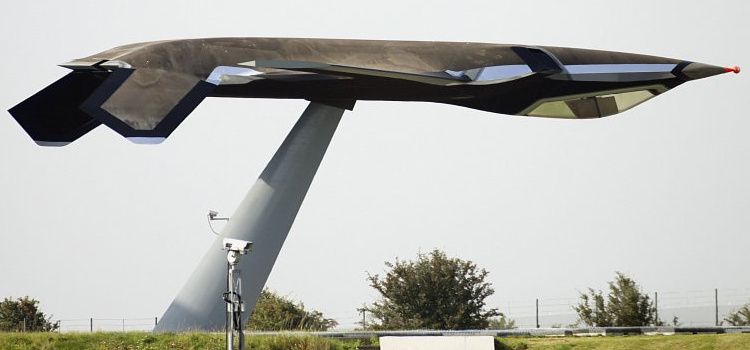
Is this video showing REPLICA - BAE's stealth aircraft pole model?

Aviation plane spotters are all abuzz over this video recently posted on YouTube showing a stealthy aircraft (pole model) being transported between buildings at BAE Warton on February 18th.

Some are speculating this is either a RCS pole model or mock-up of BAE's REPLICA study which it looks remarkably similar to except for a new grey paint scheme.

The REPLICA study was "cancelled" in the late 90s which may explain why it was being moved in plain sight and in daylight.

Does BAE have new plans for REPLICA?


Monday, February 17, 2014

Ethiopian Airlines hijacked by co-pilot - wanted asylum.


ABC NEWS: An Ethiopian Airlines co-pilot hijacked a plane bound for Rome today and flew it to Switzerland where he wanted to seek asylum, officials said.Geneva Airport chief executive Robert Deillon told reporters that the co-pilot took control of Flight ET702 when the pilot left the cockpit."The pilot went to the toilet and he [the co-pilot] locked himself in the cockpit," Deillon said.


The man "wanted asylum in Switzerland," he said. "That's the motivation of the hijacking."The flight departed Addis Ababa, Ethiopia's capital city, at 12:30 a.m. today local time. The flight was supposed to last for about six hours. The plane circled repeatedly over Switzerland before landing.

The co-pilot alerted authorities to the plane's hijacking, officials added — though passengers on the plane were unaware it had been hijacked. After landing in Geneva, the co-pilot exited the cockpit window using a rope and turned himself in to authorities.
The Associated Press contributed to this report.

LinkWithin

Blog Widget by LinkWithin