

By Steve Douglass
What was once a top secret operation so sensitive only a handful were privy to, is now the stuff of action movies and best sellers. The story of the raid that ended Osama bin Laden’s reign of terror is now on the big screen. The movie Zero Dark Thirty is a box office and critical success. Books about the raid are best sellers, such as No Easy Day by Navy Seal - Mark Owen (AKA Matt Bassinette) and The Finish (The Killing of Osama Bin Laden) by Mark Bowden, each detailing from a slightly different perspective the hunt and final disposition of the most wanted man in the world.
The almost flawless execution of the bin Laden raid will be dissected and studied in war colleges for decades to come and SEAL Team 6 will become the stuff of legend, night-vision goggle wearing dispensers of retribution, enough to make any bin Laden wannabe think twice about moving into the top spot in al-Qaeda, plagued with spending sleepless nights listening for the sound of drones overhead.
But for every action-packed frame of the movies or every thrilling word written on every page of the true accounts, there’s something that’s been glossed over or only shown in shadow, much like the shark in Jaws, remaining an enigma until the very end.
In my opinion, the real star of the movie is mysterious, shrouded in secrecy and not at all talked about in Pentagon circles. It is about the only thing that in all the official documents that has purposely been kept vague and left up to speculation. It is the Pegasus in our almost mythic saga – the stealth helicopters.
I remember when the first photos of the tail section began showing up in my e-mail. Relatives, friends and fellow stealth hunters, passed them on to me almost simultaneously asking me, “What the heck is this thing?”

Over the next 48 hours more photos began making the rounds on the aviation sites and military discussion forums. Lacking in detail but tantalizing, I imported the photos into Photoshop and analyzed them in detail. Important clues to what type of helicopter the mystery aircraft was (and crashed and was partially destroyed by the SEAL team) became evident. It wasn’t your everyday military chopper.
This bird was special.
When higher resolution photos taken by journalists and the Pakistan military began showing up on the Internet, speculation among rotor-heads was that the almost undamaged tail section was possibly a hereto unknown stealth derivative of the ubiquitous UH 60 Black Hawk.

Although the SEALS had done considerable damage in their attempt to destroy the helicopter, some parts didn't melt. Confirmation came from close-up images of the main rotor assembly. They matched the Black Hawk and (or) a close relative.
Soon after, speculative illustrations began popping up on various aviation sites. Army aviation insiders leaked the names Stealth Hawk and MX-Silent Hawk to the inquiring press, and also hinting there were two and possibly three different stealth helicopters used on the raid, a troop transport , a gunship and a larger FARP (Forward Arming & Refueling Point) heavy lift helicopter. Aviation journalists were caught flat-footed having to scramble to dig out information on several secret stealth helicopter programs where none were known to exist.
But there was one other name for a stealth helicopter that was only fleeting mentioned in aviation discussion forums and may be the only true stealth helicopter, the s-called Jedi Ride AKA Ghost Hawk. More on that later.
In most accounts there were at least one other stealth Blackhawk used to ferry SEAL Team 6, plus speculation there were two modified MH-47 Chinooks standing by with extra fuel, ammunition and also carrying a stand-by Special Forces extraction team should the raid have gone sour.
Another source says there were also two special AH-1Z Cobra gunships held in reserve in a remote location if a prolonged firefight was to break out. The worst case scenario envisioned by the Pentagon was a cadre of bin Laden loyalists and Abbottabad citizens descending on the compound en masse, leading to an extended exit under heavy fire, evidence the echoes of Black Hawk Down still reverberating through the halls of power.
Once it was officially revealed that Chinooks were involved, speculation ran rampant that they must have been modified for stealth but I’ve learned first-hand that wasn’t the case.
About a year and a half after the raid one of the 160th SOARs’ MH-47s landed at my local airport to refuel. It ended up spending the night here. I photographed it that evening and noticed the crew was tying it down for the night and decided to be there first thing in the morning to shoot more dramatic shots of the Chinook at sunrise.
I couldn’t help but notice it wasn’t your normal work-a-day Chinook . It had a fresh paint job, deep black and dark grey, much like paint job on B-2. There was an antenna array sprouting from the fuselage plus a plethora of special imaging pods and sensors on the tail and chin. Asking around I learned that it was one of the 160th SOARs Night Stalker’s MH-47G models, fresh from refurbishment in Pennsylvania and on its way to Fort Irwin in California.
The next morning I shot photos of it on the ramp and found a crew member in the restaurant adjacent to the airport. I introduced myself, thanked him for his military service and bought him breakfast.
We talked as we ate, mostly about his helicopter. Since he was with the aviation unit that was instrumental in bringing Osama bin Laden to justice I couldn’t help but ask about the 160th SOARs role in the raid. I was surprised when he told me the very bird sitting on the ramp not 100 feet from the restaurant we were eating was a major player.

He said “Although I wasn’t on the raid, I know this was one of the FARP (Forward Air Refueling Point) Chinooks, flown to an LZ a few miles away from Abbottabad and was called in when one of the Black Hawks went down. “
“Really?” I replied. “That’s impressive.”I said trying to maintain my cool.
He went on, “Yeah – in fact, bin Laden’s body and the DevGru SEALs that killed him were ferried back to Jalalabad in this helicopter. It’s unofficially been nicknamed “The Fish Food Express.” Inside there’s a painted outline where his body lay. One of these days this bird will go on display, in a museum somewhere. “
“Can I see it?” I couldn’t help but ask.
“No.” he answered bluntly.
I didn’t press him for a look-see – but I did ask him for more info on the Chinook.
“They are very loud.” I matter-of-factly remarked, more than familiar with the heavy whump-whump-whump an MH-47 makes in flight. “How does one sneak up on anyone in a Chinook?” I asked.
“Actually – in the bin Laden raid the Chinooks landed in a ravine miles north of the target – in the middle of nowhere and just sat. The raiding party flew to the compound in Black Hawks. Trying to bring them in a Chinook would have been stupid. It would have alerted everyone.” He said.
“What about Pakistan’s radar? Wouldn’t it see the Chinooks and Black Hawks?” I asked trying my best to subtlety swing the conversation around naturally to – well - the stealth Black Hawks.
“Pak radar is spotty at best- especially in the mountainous regions. It’s all been electronically mapped. We know where the holes in the fence are.” He answered.
I began mulling it over in my mind. It made sense. The special MH-47 Chinooks are outfitted to fly either high above unfriendly fire or by using terrain following radar to fly NOE (nap of the earth) missions.
He was probably right about “mapping” Pakistani radar, The US Air Force are pros at that, either by sending up a E-8C Joint Stars or other ELINT ISR drones. Gaps in Pakistan’s radar coverage could be easily ascertained.
3-D radar data collected and processed on board an E-8C in near-real-time can be sent, uninterrupted, to many flying platforms, including Special Ops Army helicopters. An E-8C can exploit Pakistani radar data relevant to the mission including passing on UAV intelligence on evolving threats and or moving target data.

An E-8C was up the night of the bin Laden raid watching and listening for any response from the Pakistani military and did (as did an airborne E3 AWACS) detect Pakistan launching two F-16s but it was only after the raiders had long since cleared Pakistan’s’ airspace.
With as many non-stealthy aircraft in the air that night how was it that bin Laden and Pakistan was caught so flat footed? It’s understandable that the stealth Black Hawks and slightly stealthy CH-47Gs flying NOE could avoid detection, but surely the plethora of support aircraft such as the E-3 AWACS, Joint Stars, and fighter support could be seen by Pakistani radar? So how could have the raid been such a surprise?
Conditioning – just like Pavlov accomplished with his famous dog. Months prior to the raid the Pentagon began “routine” airborne patrols over Afghanistan. Day after day and night after night Pakistan radar controllers were treated to a dog and pony show of sorts.

It reminded me of an incident that happened in my own town, where every night a local pawn shop’s alarm was triggered at the same time, every night for about a month. At first the police arrived in mass with guns drawn hoping to catch a burglar maybe breaking in to snatch some pawned weapons, but every time they responded they encountered no one. The false alarms continued night after night and as a result the cops responded slower and slower with more important calls taking precedent over the “stupid alarm” that mysteriously went off every night precisely at 12:06 AM. One night I heard on my police scanner a responding officer radioing, “Tell the owner that we will not be responding to anymore calls until he gets the thing fixed properly!” The next morning the owner arrived to find his entire cache of guns cleaned out.
I imagine on the night the raid a lone Pakistani radar controller, much like a rent-a-cop or mall security guard, his feet propped up on the radar console, not really watching the scopes instead his attention drawn to a TV drama on a little black and white set in the corner. Unaware he had been totally conditioned to not giving a flip about the usual armada of American planes flying seemingly in aimless and pointless circles just off the Pakistan border.
Still, the Pentagon couldn’t hang this all important mission on the hopes an inattentive Pakistani radar controller would be distracted by infomercials. The stakes were incredibly high. Capturing and (or) killing bin Laden had been a top military priority since 9-11. Secondly, the U.S. had come close several times to cornering bin Laden but somehow he had managed to slip through the grasp of the US military presumably with the help of certain sympathetic members within the ISI (Pakistan’s premier intelligence organization) passing on inside information directly to al- Qaeda.
The CIA and Pentagon were painfully aware of the leaks ever since Tora Bora and (logically) knew for the raid to be successful the Pakistan government had to remain totally in the dark, all the more reason for possibly risking the exposure of the Army’s secret stealth helicopter contingency.
Soon after the raid amid assertions that Pakistan had to be aware bin Laden was living in Abbottabad, and the resulting embarrassment to the Pak military that the U.S. could violated and penetrate Pakistan’s airspace with apparent impunity, political ties have been strained to almost beyond repair.
click to enlarge

And yet, as high as the stakes were, the “stealth” Blackhawks used in the raid was not state of the art. In fact they were based on early 90s technology, a quick and dirty LO (low observable) retrofit stealth upgrade package based on first generation stealth and more akin to the F-117 than the F-22 – except for one exception, a recently invented infrared reflecting and radar scattering iridescent silver paint and stealth (electrical continuity) gold (tinted) canopy film developed under the HAVE GLASS program.
Photos of the relatively intact tail-section that fell just outside the Abbottabad compound, attest to this fact. So far every Hollywood version of the stealthy helicopters used in the raid show them as painted flat black, like an F-117A despite photos of the debris showing (at least) the tail section being flat silver.
This radar, infrared and light scattering paint has recently been seen on the F-35, upgraded F-16s and test V-22 Ospreys at the Bell/Boeing/Textron plant in Amarillo. I photographed one of these Silver Thunder Chickens a few years ago on a rare instance when it was on the pad outside of the hangar just before a test flight.

Stealthier helicopters do exist, but their newest stealth technology was deemed by the President too secret to risk if per chance one should be shot down or crash.
Pentagon insiders refer to these cutting-edge stealth systems as “pearls too expensive to wear” and secretly grumble when they are denied using them. Military planners at the Pentagon envisioned a Black Hawk Down type scenario where armed citizens and tacit supporters of bin Laden in Abbottabad converging on the compound once they realized what was about to happen to the near-legendary leader of al Qaeda. As it would turn out, not using the more modern stealth helicopters was a good call for one did indeed crash.

There have been many educated guesses and illustrations generated by aviation enthusiasts on the internet purporting to show the look of the bin Laden raid choppers with most of these best guesses being based on the photos of the intact tail section and postulation drawn from early low-observable technology studies of the RAH-64 Comanche.

The RAH-64 Comanche was developed from the ground up as a light-attack stealth helicopter, incorporating a low-observable design (F-117-type faceting) skinned with composite radar-absorbing materials and wrapped around a diamond-shaped frame incorporating the latest (80s era) noise -dampening technology applied mostly to the rotor blades, engine and tail rotor.
Envisioned in the late 1980s, the Army wanted a fleet of hundreds of fast and stealthy armed scout helicopters able to penetrate Cold-War-era Soviet states and take out the main threat to NATO at the time, Russia’s overwhelmingly huge stockpile of tanks. But the Cold War ended and the RAH-64 became too heavy, burdened by delays and cost overruns and way too expensive. As a result it got the axe but not before the technology explored to develop stealth helicopter was quantified.
But then 9-11 happened and suddenly the CIA and the United States Naval Special Warfare Development Group (NSWDG) or DevGru (one of four secretive counter-terrorism strike forces) needed a stealthy troop transport to covertly insert SEAL teams into Pakistan and other terrorist harboring nations.
It wasn’t as simple as just dusting off the plans for the RAH-66 Comanche and going from there. Don’t forget, RAH-66 Comanche-tech was 80s stealth tech, designed to outwit Soviet radar systems.
click to enlarge

click to enlarge

Photos showing the main rotor blades being carted off by Pakistani military do not show any of the curved-sickle-like the Blue Edge type rotors being developed as an upgrade for EuroCopter or the all-composite (faceted-blade) rotors on the RAH-66 Comanche. In fact, they look like standard rotors from a UH-60 Black Hawk except they are slightly rounded and wider, most likely new wide-chord composite spar main rotor blades like the UH-60M.
click to enlarge

Some speculative artwork on internet forums shows standard four blade rotors being replaced with a five or six blade system which allows them to turn more slowly and thus more quietly, but the photos of the destroyed helicopter are not clear enough to count the number of blades on the hub. To this author it looks like a standard four blade rotor.
.jpg)

Then again, from all published accounts being quiet was not a mission breaker.
Yes, there was an attempt to silence the tail rotor with the strange “pie-plate” structure encompassing the five-blade tail rotor and although it is difficult to ascertain from the melted wreckage, the main rotor blades on the bin Laden raid helicopter do not look all that exotic and probably not designed to be very quiet.

A clue came from the book No Easy Day. CIA analysts (watching stealth RQ-170 Sentinel/GORGAN STARE image feeds of the Abbottabad compound) noticed whenever Pakistani military helicopters flew over (which they did frequently) no one, including “The Pacer (bin Laden himself) seemed to care enough to even look skyward, even out of curiosity.
That’s when it became evident that a helicopter, even a relatively noisy one could be sent in without alarming anyone in Abbottabad.
However, if you look at a current satellite image (on Google Maps) of the helicopter base at Jalalabad Airport, you’ll find a five- bladed silver helicopter tucked away by itself inside a fenced-in compound.
Could this be a Silent Hawk the returning troops said sounded like a flying waterfall? The shadow of the tail rotor doesn't look right but then again it could be a different type of covert CIA helicopter.
click to enlarge

Interestingly enough, on the night of the raid, the special stealth helicopters were heard. A Pakistani IT consultant named Sohaib Athar an Abbottabad resident tweeted: “Go away helicopter - before I take out my giant swatter!” Athar had no idea what he was tweeting live about what could turn out to be the most infamous covert raid in military history.
It stands to reason although the Blackhawks used in the bin Laden although stealthy probably weren’t that exotic looking. They were probably more akin to Shadow Spear (MH-60M Blackhawks) retrofitted with limited stealth modifications, closer in looks to the illustrations released by the Chinese.
Besides, Pakistan let the Chinese inspect the wreckage up close and in person so it stands to reason (China now the undisputed champion of reverse engineering) could logically figure out what the rest of the helicopter looked like.

click to enlarge

In the real world, the raiding party flew in, well - a kluge – a quick and dirty (and especially) expendable early solution for penetrating a third world country airspace with limited radar technology. Still very cool but nothing like what’s (reportedly) being used to ferry covert CIA and Israeli Mossad saboteurs and secret agents into Iran to subvert their nuclear weapons program.
Those are the true stealth helicopters, honed, refined and based on the latest-generation stealth technology, yet still wrapped around a tested and tried existing helicopter program.
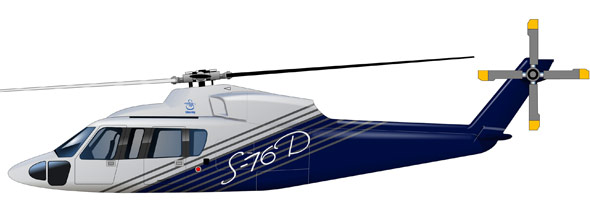
The Ghost Hawk is possibly based on the Sikorsky S-76D, and a little known NEST (Nuclear Emergency Support Team) program requiring a stealthy helicopter to get teams into nuclear Iran or North Korea.
Conventional Army Black Hawks are clunky conglomeration of add-ons and upgrades, bolted on weapons sensors, tanks and pylons hanging off the aircraft like carry-on luggage, the antithesis of stealth
Look at an F-22 or F-35. There are no rails, racks, drop tanks or weapons mounted on the outside. Everything is carried internally. Such was the same with the RAH-66 Comanche prototypes.

A true stealth helicopter would be as least as be as sleek as a Raptor, quiet, quick, silver and deadly, near zero infrared and electromagnetic emissions, essentially a Jedi ride.
As a result of the success of the bin Laden raid, stealth capabilities have taken center stage in the design of the future replacement of the now aging Black Hawk. Concepts show sleek - self contained designs, engineered for speed and stealth, but the final designs are still years out.
Until then (the still unacknowledged) Ghost Hawk will be the covert stealth insertion platform of choice.

As much as I want to see the bin Laden raid choppers, they are old school stealth. The Ghost Hawk, that’s the secret helicopter I want to see.
(C) Steve Douglass


