Thursday, April 19, 2012

Pakistan locking the barn after the horse has been stolen ...


ISLAMABAD: Pakistan has raised a 20,000 strong force to provide foolproof security to its nuclear weapons and strategic assets, the military said on Thursday.

A batch of 900 soldiers of the new 'Security Force' of the Strategic Plans Division (SPD), which is responsible for managing the country's nuclear arsenal, graduated from the Baloch and frontier force regimental centres in Abbotabad on Thursday, the military said in a statement.

"With the induction of these newly trained soldiers, the strength of the SPD Security Force touches a figure of 20,000," the statement said.

The Security Force has been raised against the backdrop of concerns expressed by politicians about Pakistan's nuclear arsenal being targeted by the US in order to prevent it from falling into the hands of extremists.

The statement said the SPD had undertaken a "comprehensive plan to significantly augment the capacity of its Security Force to ensure foolproof security of strategic assets"ISLAMABAD: Pakistan has raised a 20,000 strong force to provide foolproof security to its nuclear weapons and strategic assets, the military said on Thursday.

A batch of 900 soldiers of the new 'Security Force' of the Strategic Plans Division (SPD), which is responsible for managing the country's nuclear arsenal, graduated from the Baloch and frontier force regimental centres in Abbotabad on Thursday, the military said in a statement.

"With the induction of these newly trained soldiers, the strength of the SPD Security Force touches a figure of 20,000," the statement said.

The Security Force has been raised against the backdrop of concerns expressed by politicians about Pakistan's nuclear arsenal being targeted by the US in order to prevent it from falling into the hands of extremists.

The statement said the SPD had undertaken a "comprehensive plan to significantly augment the capacity of its Security Force to ensure foolproof security of strategic assets"

F-15s scrambled to make contact with unresponsive aircraft - Cessna crashes into Gulf


A small plane with an apparently incapacitated pilot that crashed just after 9 am in the Gulf of Mexico Thursday has sunk, said Coast Guard officials. Crews flying over the site saw no signs that its pilot survived the crash, the report said.

The Cessna twin engine propeller plane went down Thursday about three hours after two F-15 fighter jets tried to make contact with the unresponsive pilot, who was the only person onboard.

The pilot was identified as Peter Hertzak of Slidell, La., NBC station WSDU of New Orleans reported.

Coast Guard Chief John Edwards said the plane landed right-side up on the ocean surface and floated for a while, but monitoring planes did not see a life raft deploy and never made contact with the pilot.

The Coast Guard spotted the Cessna 421 twin engine propeller aircraft circling erratically over the Gulf of Mexico at about 6:30 a.m. and the pilot was unresponsive to radio calls, according to Coast Guard District 8 Chief Petty Officer John Edwards in New Orleans.

Air Force jets dispatched to look into the plane were unable to see the pilot because of fog and icing that obscured the plane's windows, Coast Guard officials said.
The two F-15s from the New Orleans National Guard were already on a mission over the Gulf said a release from Edwards.

The Jacksonville Air Traffic Control Center asked the military if jets could check on the plane, which was orbiting near one of Eglin Air Force Base's warning areas over the Gulf, Edwards said. Eglin is on Florida's Panhandle.

A federal official says the plane took off Thursday morning from Slidell, La., en route to Sarasota, Fla. The Coast Guard was contacted after air traffic control lost contact with the pilot about 6 a.m. It flew until just after noon and then crashed into the water 120 miles west of Tampa, Fla., according to the U.S. Coast Guard.

In a search and rescue effort launched in the hours before the plane crashed, the Coast Guard dispatched an HC-144 Ocean Sentry from Mobile, Ala., an MH-60 Jayhawk helicopter from Clearwater, Fla., and the Coast Guard Cutter Coho, an 87-foot patrol boat homeported in Panama City, Fla., the Coast Guard web site said.

In a previous incident involving a "ghost plane,'' in 1999, the pilot and five passengers - including professional golfer Payne Stewart - were incapacitated when their Learjet lost cabin pressure. The plane flew on for four hours before finally crashing in rural South Dakota. All six people were killed.

FLIGHTAWARE LINK

Obama presses on with stealth warship despite high cost


(AP) BATH, Maine - An enormous, expensive and technology-laden warship that some Navy leaders once tried to kill because of its cost is now viewed as an important part of the Obama administration's Asia-Pacific strategy, with advanced capabilities that the Navy's top officer says represent the Navy's future.

The stealthy, guided-missile Zumwalt that's taking shape at Bath Iron Works is the biggest destroyer ever built for the U.S. Navy.

The low-to-the-water warship will feature a wave-piercing hull, composite deckhouse, electric drive propulsion, advanced sonar, missiles, and powerful guns that fire rocket-propelled warheads as far as 100 miles. It's also longer and heavier than existing destroyers — but will have half the crew because of automated systems.

"With its stealth, incredibly capable sonar system, strike capability and lower manning requirements — this is our future," concluded Adm. Jonathan Greenert, chief of naval operations, who gave the warship his endorsement on a visit last week to Bath Iron Works, where the ships are being built.

It wasn't always this way.

The General Accounting Office expressed concerns that the Navy was trying to incorporate too much new technology. Some Navy officials pointed out that it's less capable than existing destroyers when it comes to missile defense, and a defense analyst warned that it would be vulnerable while operating close to shore for fire support.

Even its "tumblehome" hull was criticized as potentially unstable in certain situations.

The 600-foot-long ships are so big that the General Dynamics-owned shipyard spent $40 million to construct a 106-foot-tall building to assemble the giant hull segments.

And then there's the cost, roughly $3.8 billion apiece, according to the Navy's latest proposed budget.

Including research and development, the cost grows to $7 billion apiece, said Winslow Wheeler, director of the Straus Military Reform Project at the Center for Defense Information in Washington.

Because of cost, the originally envisioned 32 ships dipped to 24 and then seven. Eventually, program was truncated to just three. The first, the Zumwalt, will be christened next year and delivered to the Navy in 2014.

But Greenert told reporters that the ship fits perfectly into the new emphasis on bolstering the U.S. military presence in the Pacific in response to Asia's growing economic importance and China's rise as a military power.

Greenert didn't go into detail on how the new ship could be used. But the Defense Department has expressed concerns that China is modernizing its Navy with a near-term goal of stopping or delaying U.S. intervention in a conflict involving Taiwan. China considers the self-governing island a renegade province.

Defense officials also see a potential flashpoint in the South China Sea, where China's territorial claims overlap with those of other countries including Vietnam, the Philippines and Malaysia.

The Zumwalt's new technology will allow the warship to deter and defeat aggression and to maintain operations in areas where an enemy seeks to deny access, both on the open ocean and in operations closer to shore, the Navy says.

Jay Korman, industry analyst with The Avascent Group, said the warship uses so much new technology that it's viewed by the Navy as a "silver bullet" answer to threats. The only problem is the cost.

"They were looking to introduce so many new technologies at once, and the cost ballooned," he said. "I don't think people have changed their minds that it's a capable ship. It's just too expensive."

Unlike another new ship entering the Navy's arsenal — the small and speedy "littoral combat ship" — the Zumwalt will be heavily armored and armed.

The Zumwalt's 155 mm deck guns were built to pound the shore with guided projectiles to pave the way for the Marines to arrive in landing craft, and they're far more cost-effective in certain situations than cruise missiles, said Eric Wertheim, author of the "Naval Institute's Guide to Combat Fleets of the World."

The smaller crew also represents a substantial cost savings, he added.

Down the road, the ship could one day be equipped with an electromagnetic railgun, a powerful weapon that uses a magnetic field and electric current to fire a projectile at several times the speed of sound.

Production will stop after three ships, and the Navy will go back to building tried-and-true Arleigh Burke-class destroyers, 510-foot-long ships featuring a versatile Aegis radar system that's being modified for ballistic missile defense. Even with modifications, the ships will cost far less than the Zumwalt-class ships.

For Bath's 5,400 workers, the Zumwalt has been both exciting and challenging, with a new design and new construction techniques. In the coming months, workers will take delivery of the composite deck house and helicopter hangar, which are being built at the Huntington Ingalls shipyard in Mississippi. Those will be placed on the Bath-built hull.

"If anybody can do it and do it successfully, then I'm confident that's us," said Jay Wadleigh, vice president of Local S6 of the Machinists Union in Bath.

READ THE REST OF THE STORY HERE

CIA wants to step up drone war on terror ..


By Greg Miller

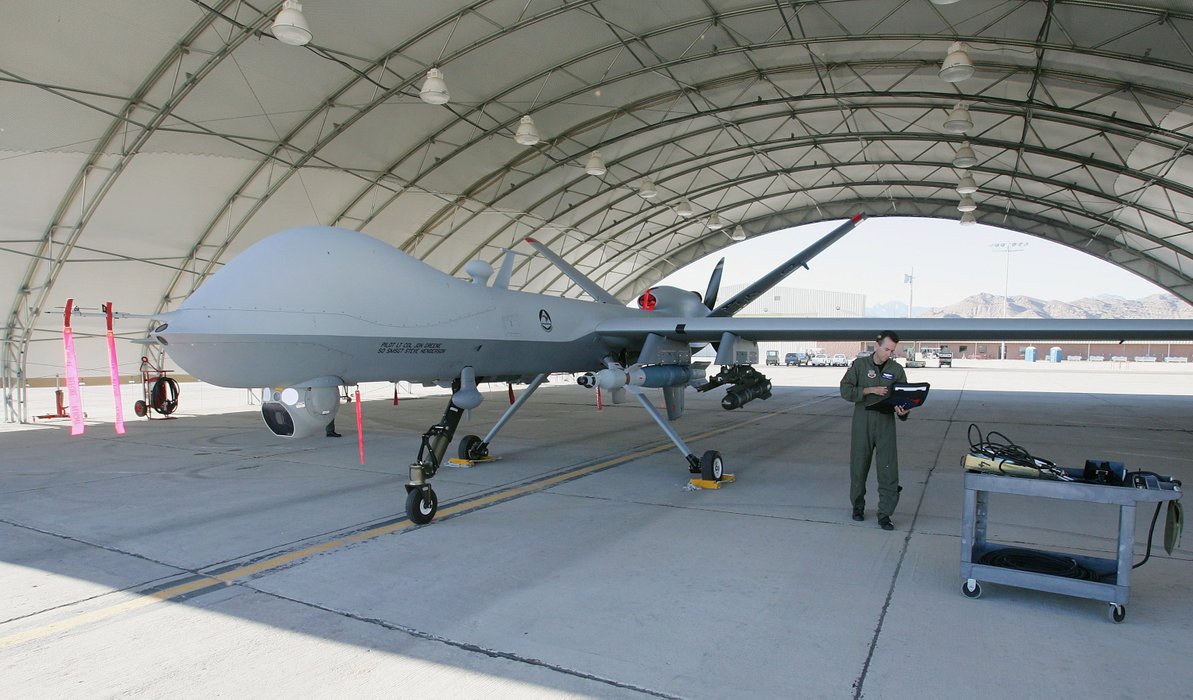
The CIA is seeking authority to expand its covert drone campaign in Yemen by launching strikes against terrorism suspects even when it does not know the identities of those who could be killed, U.S. officials said.

Securing permission to use these “signature strikes” would allow the agency to hit targets based solely on intelligence indicating patterns of suspicious behavior, such as imagery showing militants gathering at known al-Qaeda compounds or unloading explosives.

Violence in Yemen has repeatedly erupted between government and opposition forces, as well as between the government and al-Qaeda.

The practice has been a core element of the CIA’s drone program in Pakistan for several years. CIA Director David H. Petraeus has requested permission to use the tactic against the al-Qaeda affiliate in Yemen, which has emerged as the most pressing terrorism threat to the United States, officials said.

If approved, the change would probably accelerate a campaign of U.S. airstrikes in Yemen that is already on a record pace, with at least eight attacks in the past four months.

For President Obama, an endorsement of signature strikes would mean a significant, and potentially risky, policy shift. The administration has placed tight limits on drone operations in Yemen to avoid being drawn into an often murky regional conflict and risk turning militants with local agendas into al-Qaeda recruits.

A senior administration official, who like others spoke on the condition of anonymity to discuss sensitive internal deliberations, declined to talk about what he described as U.S. “tactics” in Yemen, but he said that “there is still a very firm emphasis on being surgical and targeting only those who have a direct interest in attacking the United States.”

U.S. officials acknowledge that the standard has not always been upheld. Last year, a U.S. drone strike inadvertently killed the American son of al-Qaeda leader Anwar al-Awlaki. The teenager had never been accused of terrorist activity and was killed in a strike aimed at other militants.

Some U.S. officials have voiced concern that such incidents could become more frequent if the CIA is given the authority to use signature strikes.

READ THE REST OF THE STORY HERE

Jet Blue pilot using insanity defense


Reuters - A JetBlue pilot whose midair meltdown prompted a cross-country flight to make an emergency landing in west Texas last month will plead he was insane at the time of the incident, his lawyer said in a federal court filing on Wednesday.

Attorney Dean Roper filed the notice in U.S. District Court in Amarillo, Texas, saying pilot Clayton Osbon would use an insanity defense.

Osbon, 49, was charged earlier this month with interfering in the operations of a flight crew after he allegedly screamed and pounded on the cockpit door, forcing a March 27 flight from New York to Las Vegas to land in Amarillo.

Osbon was undergoing court-ordered psychiatric examination to determine if he could stand trial. The outcome of those examinations has not been disclosed.

A federal indictment described a harrowing flight during which Osbon had to be subdued and forcibly restrained from re-entering the cockpit.

The FBI said Osbon began saying, "Things just don't matter" while he was at the controls of the Airbus A320 about halfway into the five-hour flight, and that he told the flight's first officer, "We're not going to Vegas."

After the pilot suddenly left the cockpit and started running up and down the aisle, banging on a restroom door, and attempted to force his way back into the locked cockpit, several passengers restrained him until the plane landed.

The FBI said that while he was being restrained, Osbon yelled, "Pray now for Jesus Christ," started yelling about Iraq, Iran and terrorists, and shouted at one point toward the cockpit, "Guys, push it to full throttle!"

Neither Osbon's lawyer nor prosecutors could immediately be reached for comment on the insanity defense.

LinkWithin

Blog Widget by LinkWithin